
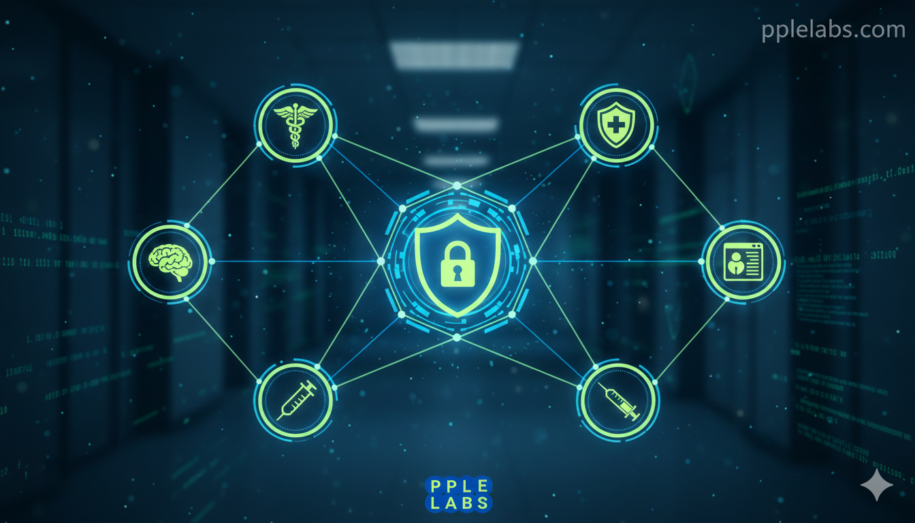
The healthcare industry is currently undergoing a massive transformation where “silicon employees” are taking over complex tasks. To make this work, Agentic API in Healthcare serves as the vital nervous system. Unlike the old days where a human had to click a button to send data, these new agents talk to each other on their own. They share records, update treatment plans, and even coordinate surgery schedules. But with this independence comes a massive risk. If we don’t secure these digital conversations, we open the door to unprecedented data breaches.
1. The Architecture of a Secure Agentic API in Healthcare
Building a safe environment for medical agents requires a complete rethink of how we handle connections. In a traditional setup, you might have a firewall that keeps the bad guys out. However, in an agentic mesh, the threat could come from within if an agent is compromised. We need to treat every single request as a potential threat. This is why a secure Agentic API in Healthcare must be built on a foundation of constant verification.
1.1 Implementing Zero Trust at the agent level
The old rule of “trust but verify” is officially dead in 2026. Instead, we have moved to a model where no agent is trusted by default. Every time one agent asks another for a patient’s lab results, it must prove its identity and its right to see that specific data. This approach is vital for Bio Digital Twin Security where digital agents move sensitive biological blueprints between systems. By assuming a breach is always possible, you create a much more resilient defense.
1.2 The role of mutual TLS in agent-to-agent talk
To keep these conversations private, we use mutual Transport Layer Security (mTLS). This ensures that both sides of the API call are who they say they are. It creates an encrypted tunnel that even a sophisticated hacker cannot peek into. Think of it like a secure handoff between two high-security couriers. In the world of Agentic AI Healthcare, this level of encryption is the bare minimum for staying compliant.
2. Managing Governance for Agentic API in Healthcare
Just because an agent can work 24/7 doesn’t mean it should work without a boss. Governance is the process of setting the rules for what these agents can and cannot do. Without strict oversight, an autonomous agent might try to optimize a workflow in a way that accidentally violates patient privacy. Managing an Agentic API in Healthcare means having a digital manager watching over every connection.
2.1 Automated auditing for silicon employees
One of the biggest benefits of these new systems is that they can record every single action they take. We use automated auditing tools to watch the traffic patterns of the Agentic API in Healthcare. If an agent suddenly starts requesting ten times more data than usual, the system can automatically cut its access. This proactive defense is a key part of Proactive Healthcare Cybersecurity today. It turns a static network into a self-defending ecosystem.
2.2 Policy enforcement in real-time workflows
Policies should not be buried in a PDF file; they must be baked into the code. When an agent attempts to access a pharmacy record, the API gateway checks against real-time rules. Does this agent have the right credentials? Is the patient’s consent currently active? If the answer is no, the request is blocked instantly. This helps prevent Shadow AI Risks where unauthorized tools try to sneak into the clinical workflow.
3. Addressing Vulnerabilities in Agentic API
Hackers are getting smarter, and they are now targeting the logic of the agents themselves. A secure Agentic API in Healthcare must be protected against more than just brute force attacks. We have to worry about how the agents “think” and process instructions. If an attacker can trick an agent, they can bypass even the strongest firewalls.
3.1 Guarding against prompt injection in API calls
Since many of these agents use Large Language Models (LLMs) to understand requests, they are vulnerable to prompt injection. This is where a hacker hides a command inside a regular data field to make the agent do something it shouldn’t. Securing your Agentic API in Healthcare requires robust input validation. You have to treat every piece of data as if it were a dangerous virus. For more on this, you can look at the latest research on Medical LLM Security to see how experts are defending clinical models.
3.2 Protecting the integrity of patient data replicas
When agents are working with digital twins or replicas of patients, the data must remain perfectly accurate. If an agent modifies a record incorrectly, it could lead to a medical error. We use cryptographic signatures to ensure that the data moving through the Agentic API in Healthcare has not been tampered with. This is a core part of protecting the Synthetic Medical Data that we use for training and research.
4. Future-Proofing Agentic API in for 2026
As we look toward the end of the decade, the technology will only get more complex. The standard encryption we use today might not be enough in a few years. We need to build our Agentic API in Healthcare with the future in mind. This means looking at quantum-resistant math and localized data control to stay ahead of the curve.
4.1 Moving toward sovereign AI ecosystems
Many hospitals are now moving away from the public cloud to keep their data local. This is known as Sovereign AI Healthcare, where the AI “brain” stays inside the hospital walls. By keeping the Agentic API in Healthcare within a controlled local network, you drastically reduce the surface area that a hacker can attack. It’s like keeping your most valuable treasures in a private vault instead of a public storage unit.
4.2 The impact of decentralized identity for agents
In the future, agents will have their own unique “digital passports” based on blockchain or other decentralized technologies. This will make it much harder for a bad actor to impersonate a medical agent. When an Agentic API in Healthcare receives a request, it will check this immutable record to confirm the agent’s history and reputation. This creates a world where trust is built into the very fabric of the internet.
Conclusion
Securing the communication between medical agents is not just a technical challenge; it is a moral one. As we rely more on Agentic API in Healthcare, we must ensure that patient trust remains at the center of everything we do. By implementing zero trust, strict governance, and future-proof encryption, we can enjoy the benefits of an automated hospital without the fear of a digital catastrophe. The goal is to build a system that is as smart as it is safe.
Frequently Asked Questions (FAQs)
1. What is the main goal of securing Agentic API in Healthcare? The primary goal is to protect the autonomous communication between AI agents. This ensures that sensitive patient data is not leaked or tampered with as it moves through various hospital workflows.
2. Is Agentic API in Healthcare required for HIPAA compliance? While the term itself isn’t in the law, the security principles it requires—like encryption, access control, and audit trails—are mandatory for staying HIPAA compliant in 2026.
3. How does Zero Trust apply to Agentic API in Healthcare? In a Zero Trust model, no agent or device is trusted automatically. Every request made via an API must be verified with credentials and checked against current permissions before any data is shared.
4. Can hackers use prompt injection to attack an Agentic API ? Yes, if an agent uses an LLM to process API requests, a hacker could use malicious prompts to trick the agent into giving away data or changing its behavior. This is why strict input filtering is essential.
5. How does Sovereign AI improve the security of an Agentic API in Healthcare? Sovereign AI keeps the data and the processing local. This means the API calls never have to leave the hospital’s secure network, which makes it much harder for external attackers to intercept them.
For more information on the evolving landscape of medical technology, visit the HHS Security portal, check out the NIST AI Risk Framework, or read the latest on API Security from OWASP. You can also explore the Cloud Security Alliance guidelines for healthcare.
Leave a Reply