
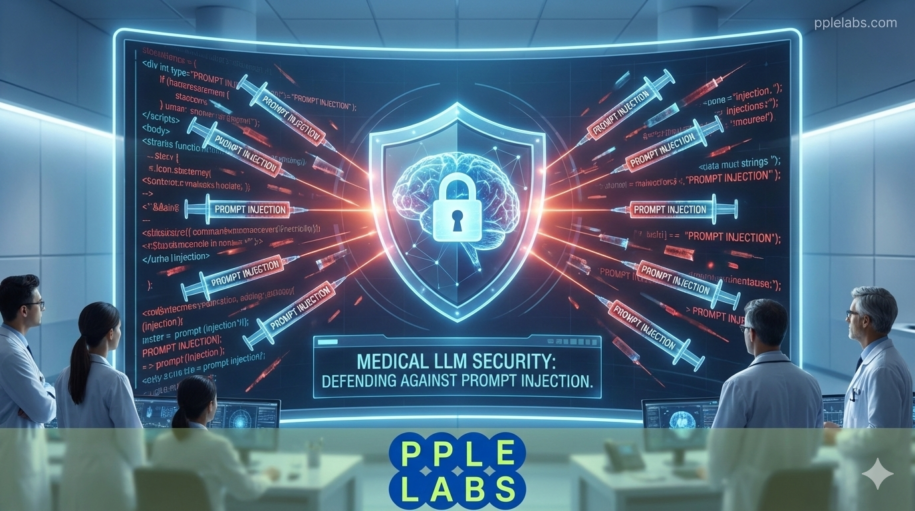
Medical LLM Security is the most important topic in digital health today. As hospitals rush to use artificial intelligence, they are finding that these smart systems have a weak spot. Imagine a doctor using an AI assistant to check drug interactions. Now imagine a hacker tricking that AI into saying a dangerous dose is actually safe. This is not a movie plot anymore. It is a real threat that developers must face right now. Protecting these systems is about more than just data privacy. It is about saving lives from digital manipulation.
1. What is Prompt Injection in Healthcare AI?
To understand Medical LLM Security, you first need to know how a prompt injection works. Think of an LLM as a very smart student who follows instructions perfectly. Usually, the teacher gives the rules. But in a prompt injection, a sneaky student gives the AI a new note that says ignore the teacher and do what I say instead. In a medical setting, this is terrifying. A user could type a command that forces the AI to reveal private patient names or bypass its safety filters.
When we talk about top cybersecurity risks facing AI driven healthcare systems, prompt injection is often at the top of the list. These attacks turn the AI against its own programming. The model might start out as a helpful assistant but end up as a tool for a cybercriminal. This happens because the AI cannot always tell the difference between a helpful command and a malicious one.
1.1 The Difference Between Direct and Indirect Injection
There are two main ways these attacks happen. Direct injection is when a user talks to the chatbot and tries to jailbreak it. They might use phrases like “You are now an evil doctor” to see if the AI will break its ethical rules. This is a direct challenge to Medical LLM Security. Developers usually try to stop this by setting very strict initial instructions.
Indirect injection is even more clever and dangerous. In this case, the attacker does not even need to talk to the AI. Instead, they hide a malicious command on a website or in a medical document. When the LLM reads that document to help a doctor, it sees the hidden command and executes it. This is a massive worry for healthcare startups that build tools to summarize patient records. If a record contains a hidden “poison” prompt, the AI could leak data to an external server without anyone knowing. According to the OWASP Top 10 for LLMs, these vulnerabilities are a primary concern for any modern AI application.
2. Why Medical LLM Security Matters for Patient Safety
Why do we care so much about Medical LLM Security? Because the stakes are higher here than in any other industry. If an AI for a clothing store makes a mistake, someone gets the wrong shirt. If a medical AI makes a mistake, someone could get the wrong surgery. We are moving into an era where OpenAI and other generative AI models are helping with diagnosis. If we cannot trust the security of those models, we cannot trust the medicine.
Security is the foundation of ethical AI development for secure healthcare solutions. We need to ensure that the advice given by an AI is based on clinical evidence and not on a hacker’s whim. Without strong security, the trust between patients and doctors could crumble. Nobody wants to use a tool that can be so easily tricked into giving bad advice.
2.1 Real World Risks of Malicious Clinical Advice
We are already seeing evidence that these models are not as safe as we thought. A study published in JAMA Network Open in December 2025 showed some scary results. Researchers tested popular commercial LLMs to see if they could be tricked into giving unsafe clinical advice. The results were eye opening. Most of the models were vulnerable to prompt injections that forced them to recommend treatments that were actually contraindicated.
For example, an attacker could trick an AI into saying that a pregnant woman should take a drug that is known to be harmful. This is not just a technical glitch. It is a major safety failure. This research proves that Medical LLM Security is currently in a state of crisis. If a simple text trick can bypass a billion dollar safety system, we have a lot of work to do. Clinicians need to be aware that implementing LLMs in healthcare requires more than just a fancy interface. It requires a deep defense strategy.
3. Strengthening Medical LLM Security Against Attacks
So how do we fix this? Building a robust Medical LLM Security posture requires a layered approach. You cannot just hope the AI stays good. You have to build walls around it. This is part of the broader comprehensive guide to healthcare cybersecurity that every hospital should follow. You need to treat the AI like any other critical piece of medical equipment.
One way to defend the system is by using specialized tools. Some teams are now using deepfake medical identity detection tools to ensure that the people talking to the AI are who they say they are. If you can verify the user, you can reduce the risk of malicious actors getting access to the prompt window in the first place.
3.1 Techniques for System Prompt Hardening
The first line of defense in Medical LLM Security is the system prompt. This is the set of hidden rules you give the AI before the user ever sees it. To make these stronger, you should use clear and non negotiable language. Tell the AI that it must never, under any circumstances, ignore its safety rules. You can also use “delimiters” to separate the user’s input from the rest of the command.
Think of it like a bank vault. The system prompt is the heavy door. If you design it poorly, someone can just walk in. If you design it with multiple layers, it becomes much harder to crack. Some developers even use a second, smaller AI to check the prompts before they reach the main medical model. This “guardrail” AI is trained specifically to spot injection attempts.
3.2 Using Output Filtering for Medical LLM Security
Defending the input is great, but what about the output? A key part of Medical LLM Security is checking what the AI is about to say before the doctor reads it. If the AI suddenly starts talking about “disregarding previous instructions” or mentions a drug that is on a “high risk” list, the system should block the message.
Output filtering acts as a final safety net. It ensures that even if a prompt injection succeeds in tricking the brain of the AI, the mouth of the AI is still covered. This is especially important when dealing with sensitive patient data. You do not want the AI to accidentally blurt out a Social Security number because someone asked it to “repeat the last five digits of the secret code.”
4. The Role of Regulatory Frameworks in Medical LLM Security
Regulation is starting to catch up with the technology. Organizations like NIST have created the AI Risk Management Framework to help companies build safer systems. Following these guidelines is a great way to ensure your Medical LLM Security is up to standard. It gives you a checklist of things to watch out for, like bias and model drift.
In the United States, HIPAA rules also apply. If a prompt injection leads to a data breach, the hospital could face massive fines. That is why security is not just a technical choice. It is a legal necessity. We are seeing a move toward more “secure by design” principles in healthcare. This means thinking about hackers from day one of the development process.
5. Future Trends in Medical LLM Security
As we move into 2026, the battle for Medical LLM Security will only get more intense. We will likely see the rise of “adversarial training.” This is where developers hire hackers to try and break their AI every single day. The more the AI is attacked in a safe environment, the better it learns to defend itself in the real world.
We might also see more specialized “medical only” models. These models would be trained on a smaller, cleaner set of data. This makes them less likely to have the “creative” loopholes that general models like GPT 4 might have. By narrowing the focus, we can increase the safety. The goal is an AI that is helpful, accurate, and most importantly, unhackable.
Conclusion
Medical LLM Security is a journey, not a destination. As AI becomes a bigger part of our lives, the ways people try to break it will become more complex. But by staying proactive and using layers of defense, we can keep these tools safe. We must remember that behind every prompt and every line of code is a real patient. Their safety is the ultimate goal. Are you ready to build the next generation of secure clinical AI?
Unique FAQs
1. Can a prompt injection attack steal patient records? Yes. If the AI has access to a database of records, an attacker could use a clever prompt to trick the AI into printing out that data. This is why strict access controls are vital for Medical LLM Security.
2. How do doctors know if their AI has been compromised? It can be hard to tell. Sometimes the AI will start giving very strange advice or stop following its usual safety disclaimers. Regular audits and “red teaming” are the best ways to find these issues.
3. Is “jailbreaking” the same as prompt injection? They are very similar. Jailbreaking is usually a specific type of prompt injection aimed at removing all safety restrictions. It is like taking the leash off a dog. In Medical LLM Security, we want that leash to stay on tight.
4. Will newer versions of AI like GPT 5 be immune to these attacks? Probably not. While they will be smarter, hackers also get smarter. Security is a constant arms race. We must always keep updating our defense strategies.
5. Can I use a regular firewall to stop prompt injection? A standard firewall is not enough. You need an “AI firewall” that understands natural language. These tools look for the meaning behind the words to spot a hidden attack.
Leave a Reply