
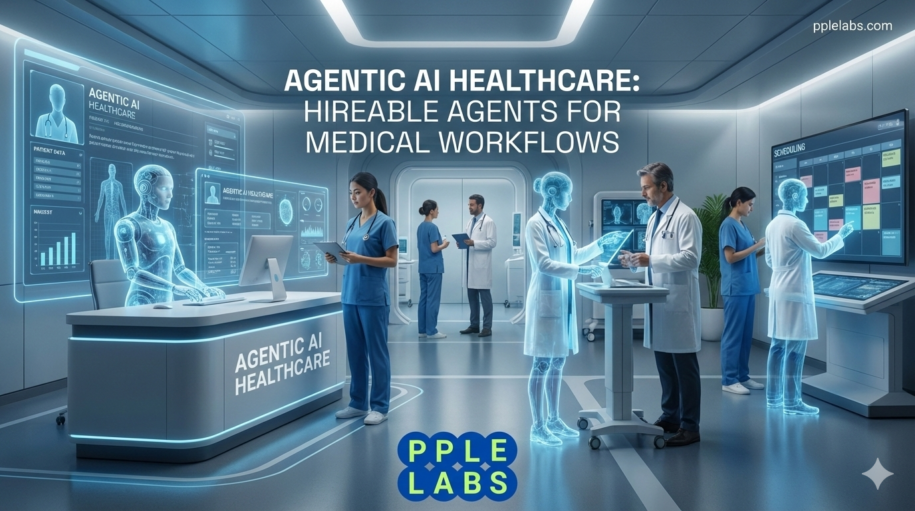
The medical world is witnessing a massive shift right now. We are no longer just looking at tools that help us type faster or search through records. Today, Agentic AI Healthcare has arrived as a fleet of hireable digital agents capable of managing complex medical workflows autonomously. In early 2026, hospitals are moving past simple chatbots and embracing systems that can think, plan, and act. These agents do not just answer questions; they complete jobs. Imagine a digital employee that handles patient intake, insurance verification, and follow up calls without needing constant supervision. This technology is changing the definition of a medical workforce.
For years, the industry talked about digital transformation as a vague goal. Now, it is a practical reality. Organizations are looking at these agents as labor rather than just software. This shift is necessary because healthcare systems are under more pressure than ever. Staffing shortages are common and burnout is at an all time high. By bringing Agentic AI Healthcare into the clinical environment, we are giving human professionals their time back. You can see how this movement started by looking at how digital transformation in 2025 set the stage for autonomous systems.
- Understanding Agentic AI Healthcare as Digital Coworkers
What does it actually mean to hire an AI agent? In the context of Agentic AI Healthcare, it means deploying a software entity that possesses a specific set of skills and the authority to use them. These agents function like digital coworkers. They have memory, they understand context, and they can use professional tools just like a human would. Instead of a doctor having to click through twenty screens to order a test, they can simply tell the agent to handle it. The agent then logs into the system, checks the patient history, ensures compliance, and submits the order.
This is a level of sophistication that was once the stuff of science fiction. These agents are built on frameworks that allow them to reason through problems. If a pharmacy is closed, the agent knows to look for the next closest one or alert the patient. This kind of proactive behavior is the hallmark of modern AgentKit in Healthcare applications. These are not just scripts; they are dynamic entities that adapt to the messy reality of clinical work.
- How Agentic AI Healthcare Differs from Standard Automation
You might wonder how this is different from the automation we have used for a decade. Standard automation is like a train on a track. It can only go where the rails are laid. If there is an obstacle, the train stops. Agentic AI Healthcare is more like a delivery driver. It has a destination and a set of rules, but it can navigate around a closed road or find a new path if the first one is blocked. This ability to handle uncertainty is what makes these agents “agentic.”
Traditional software requires a human to initiate every single step. In contrast, an agent can be given a high level goal such as “prepare this patient for discharge.” The agent then figures out that it needs to coordinate with the pharmacy, notify the family, and update the bed management system. It doesn’t need a human to trigger each of those sub tasks. This autonomy is why leading organizations like the World Health Organization are closely watching how AI changes the role of the health worker.
- Deploying Agentic AI Healthcare for Prior Authorization
One of the biggest headaches in medicine is dealing with insurance companies. Prior authorization often involves hours of paperwork and phone calls. By using Agentic AI Healthcare, hospitals can now automate this entire cycle. These hireable agents can read a doctor’s notes, extract the necessary clinical data, and submit it to the payer portal. If the insurance company asks for more information, the agent can find that data in the medical record and send it over immediately.
This is a massive win for efficiency. It reduces the time patients have to wait for critical treatments. Instead of waiting days for a human to process a request, an agent can do it in minutes. This type of enterprise AI logic allows for a level of speed that was previously impossible. It turns a slow, manual process into a fast, digital workflow that works in the background while doctors focus on the person sitting in front of them.
- Enhancing Triage with Agentic AI Healthcare Reasoning
Triage is the art of deciding who needs help first. It is a high stakes task that requires intense focus. Agentic AI Healthcare agents are now being used to support this process by analyzing incoming patient data in real time. They can look at vital signs, symptoms, and historical records to flag high risk cases before they become emergencies. This isn’t just a simple alert system; it is a reasoning engine that understands the nuances of clinical risk.
For example, an agent might notice a subtle trend in a patient’s blood pressure that a busy nurse might miss. It can then prompt the clinical team to take action. This collaborative approach is seen in specialized fields like AI in radiology, where systems help prioritize the most urgent scans. By acting as a digital safety net, these agents ensure that no patient falls through the cracks during a busy shift.
- The Orchestration of Multi Agent Agentic AI Healthcare Systems
The true power of this technology emerges when multiple agents work together. In a modern hospital, you might have one agent focused on patient communication, another handling logistics, and a third managing clinical documentation. A multi agent system allows these entities to talk to each other. When the clinical agent notes that a patient is ready to go home, it tells the logistics agent to call for a transport van and notifies the billing agent to finalize the charges.
This orchestration creates a seamless flow of information. It eliminates the “silos” that usually slow down hospital operations. You can think of it as a well rehearsed orchestra where every player knows their part and listens to the others. This concept of business and everyday AI agents is now being tailored specifically for the high stakes environment of a clinic. The result is a hospital that runs more like a software system than a manual bureaucracy.
- Privacy and Guardrails in Agentic AI Healthcare
With great power comes the need for great responsibility. Handling medical data requires the highest level of security. Agentic AI Healthcare must be built with strict guardrails to ensure patient privacy. These agents are designed to follow HIPAA regulations and other legal frameworks strictly. They operate within secure environments where every action they take is logged and auditable.
Human in the loop systems are a key part of this security. Even though the agents are autonomous, they are not unsupervised. For sensitive decisions, the agent will present its reasoning to a human professional for approval. This ensures that the final word always belongs to a qualified person. Organizations like HIMSS provide guidelines on how to maintain these high standards as we integrate more AI into our systems.
- Integrating Agentic AI Healthcare into Existing EHR Systems
A common fear is that new technology will require a total overhaul of existing systems. Fortunately, Agentic AI Healthcare is designed to sit on top of what you already have. These agents can interact with Electronic Health Records (EHR) through APIs or even by navigating the user interface like a human would. This means hospitals can get the benefits of AI without having to replace their multi million dollar software platforms.
Integration is also happening on the hardware side. We are seeing agents that can communicate with Meta AR glasses in healthcare to provide hands free data to nurses on the floor. Imagine a nurse looking at a patient and seeing their current medication list overlaid on their vision, powered by an agent that is updating that data in real time. This is how we bridge the gap between digital intelligence and physical care.
- Future Trends and the ROI of Agentic AI Healthcare
As we look toward the end of 2026, the return on investment for Agentic AI Healthcare is becoming clear. Hospitals are reporting significant drops in administrative costs and improvements in patient outcomes. By automating the “boring” parts of the job, they are able to retain staff longer and provide better care. The market for these agents is exploding as providers realize that they cannot afford to stay manual.
In the future, we will see even more specialized agents. We might have agents dedicated to genomic analysis or personalized nutrition. The possibilities are endless. For the latest research on these trends, many professionals turn to authority sources like Nature Medicine to see how peer reviewed studies are validating these new models of care. The data shows that those who adopt early are gaining a massive competitive advantage.
Conclusion
Agentic AI Healthcare is not just another tech trend. It is a fundamental shift in how we manage the business and practice of medicine. By deploying hireable agents that can reason and act, we are creating a more resilient healthcare system. These digital coworkers take on the burden of the “paperwork” so that humans can focus on the “peoplework.” As we move further into 2026, the integration of these autonomous agents will become the standard for any high performing medical facility. Are you ready to hire your first digital clinical assistant?
Frequently Asked Questions
- What is the main benefit of Agentic AI Healthcare? The primary benefit is the reduction of administrative and clinical burden on human staff. By automating complex workflows like prior authorization and triage, these agents allow doctors and nurses to spend more time with patients.
- Can Agentic AI Healthcare replace human doctors? No, these agents are designed to be digital coworkers that support humans. They handle repetitive and data intensive tasks, but the final clinical judgment and the empathetic aspect of care always remain with the human professional.
- How do you ensure the security of patient data? Agents are built within secure, compliant frameworks. Every action is logged, and they are programmed to follow strict privacy laws. Human oversight is always integrated into the workflow for sensitive decisions.
- Is it difficult to integrate these agents into old hospital systems? Most modern agents are designed to work with existing Electronic Health Records. They use standard interfaces and APIs, which means you don’t need to replace your entire infrastructure to start using them.
- What kind of tasks can these hireable agents perform? They can handle patient intake, schedule appointments, process insurance claims, monitor vital signs for alerts, and even assist in clinical reasoning by analyzing large sets of medical data quickly.
Leave a Reply