
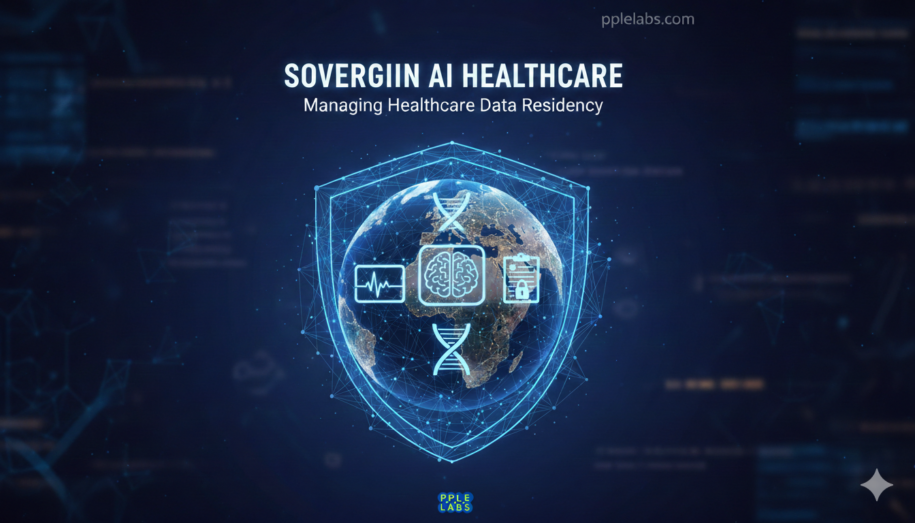
The medical world is moving fast. By early 2026, the old ways of sending every bit of patient data to a distant cloud have started to fade. Enter Sovereign AI Healthcare, a specialized approach where AI doesn’t just work for the doctor, it stays within the hospital’s walls. Have you ever wondered where your medical records go when a computer analyzes them? For a long time, the answer was “somewhere in the cloud.” But today, privacy is the new currency.
Sovereign AI Healthcare represents the fusion of high performance computing and strict national or local control. It ensures that the “brain” of the hospital stays on the property. This isn’t just a trend for tech enthusiasts; it is a vital shift for anyone handling sensitive human stories. With new regulations favoring local control, the move toward localized models is no longer optional.
2. The Shift Toward Localized AI Models
Why are we seeing this massive pivot? In simple terms, generic AI models often miss the mark when it comes to specialized medical tasks. Sovereign AI Healthcare prioritizes localized models that understand the specific nuances of a region’s language, medical codes, and legal requirements.
These localized systems act like a private library. Instead of a public database that everyone can access, a hospital builds its own vault. This approach reduces the risk of data leaks while increasing the accuracy of the AI. When a model is trained on local data, it becomes a better assistant for the doctors in that specific community.
3. Why Data Residency Is Non-Negotiable in 2026
Data residency isn’t just a buzzword anymore; it is the law. In 2026, we are seeing the full impact of the European Health Data Space (EHDS) regulations, which demand that health information stays within specific borders. Sovereign AI Healthcare provides the infrastructure needed to meet these “geopatriation” requirements.
Think of it as a digital boundary. If a patient in Berlin has an MRI, that data shouldn’t be processed on a server in another continent. Keeping it local protects the patient’s right to privacy and keeps the hospital out of legal trouble. Organizations that ignore this are facing massive fines and a loss of public trust.
4. How Sovereign AI Healthcare Solves Compliance Hurdles
Navigating HIPAA and other global standards can feel like walking through a minefield. One wrong step and you have a breach on your hands. Sovereign AI Healthcare acts as a safety net. By keeping processing local, you eliminate many of the risks associated with third party cloud providers.
- Audit Trails: Every interaction with the AI is logged within the hospital’s own secure environment.
- Access Control: Only authorized staff can touch the data, satisfying strict Multi Modal AI Privacy standards.
- Quantum Readiness: Many sovereign systems now include Post Quantum Cryptography for Healthcare Security to protect against future threats.
5. The Role of Edge Computing in Data Localization
How do we actually keep the data from leaving the building? The answer lies in edge computing. Sovereign AI Healthcare relies on powerful hardware located right at the source of the data. Instead of sending a massive file to a central server, the AI “comes to the data.”
This is especially crucial for devices like wearables. As we’ve seen with Edge AI in Wearables, processing information on the device itself means instant alerts and zero data travel. It’s like having a tiny, expert doctor living inside the machine.
6. Benefits of Local LLM Deployment for Hospitals
Deploying Large Language Models (LLMs) locally is a game changer. When a hospital runs its own Sovereign AI Healthcare stack, it gains speed and reliability. Have you ever experienced a “cloud outage” that stopped your work? With a local setup, that doesn’t happen.
Doctors can use these models for Clinical Documentation without worrying about a hacker intercepting the stream. It turns a flood of raw notes into actionable insights in seconds. Because the model is sovereign, the hospital owns the intellectual property of the training process, not a big tech company.
7. Comparing Sovereign AI Healthcare vs. Public Cloud
| Feature | Public Cloud AI | Sovereign AI Healthcare |
| Data Location | Global / Distributed | Local / Specific |
| Compliance | Shared Responsibility | Full Local Control |
| Latency | Higher (Network Dependent) | Ultra Low (On site) |
| Customization | General Models | Domain Specific Models |
While the public cloud is great for general tasks, it often fails the strict “local only” test required for modern medicine. Using Sovereign AI Healthcare means you don’t have to compromise on security to get the latest tech.
8. Addressing Geopatriation and Local Governance
Geopatriation is the act of bringing data back to its home country. This is a core pillar of Sovereign AI Healthcare. Governments are realizing that health data is a strategic asset. By using Nvidia GPUs and local data centers, nations can build their own AI ecosystems.
This local governance prevents foreign entities from having a “kill switch” over a country’s medical services. It ensures that the AI reflects the values and ethics of the people it serves. It’s about digital independence as much as it is about medicine.
9. The Future of Sovereign AI Healthcare Systems
What’s next? We are heading toward a world where Synthetic Medical Data is used to train these sovereign models even further. This allows for innovation without ever using a real person’s name. The future of Sovereign AI Healthcare is one where the system is invisible but everywhere, protecting us while keeping our secrets safe.
We will likely see more hospitals joining “sovereign clouds”—shared local networks that are private but collaborative. This allows for the benefits of big data without the risks of global exposure. The goal is simple: better care, absolute privacy.
Conclusion
In the end, Sovereign AI Healthcare is about trust. It is the bridge between the incredible power of artificial intelligence and the human need for privacy. By moving toward localized AI models and strict data residency, we are making sure that the future of medicine is not just smart, but safe. Hospitals that embrace this shift now will be the leaders of the 2026 landscape. They are choosing to protect the human stories behind the data points.
Frequently Asked Questions (FAQs)
1. What is the main difference between regular AI and Sovereign AI Healthcare?
The main difference is where the data lives and who controls the model. Regular AI often uses global cloud servers, while sovereign systems keep everything local to comply with residency laws.
2. Is Sovereign AI Healthcare more expensive to set up?
Initially, the hardware costs for local GPU clusters can be higher. However, it often saves money in the long run by avoiding cloud subscription fees and potential regulatory fines.
3. Does this technology help with HIPAA compliance?
Yes. By ensuring data never leaves a secure, local environment, it simplifies the compliance process and reduces the “attack surface” for hackers.
4. Can small clinics afford Sovereign AI Healthcare?
Absolutely. Thanks to edge computing and “AI in a box” solutions, even smaller practices can now deploy localized models without needing a massive data center.
5. Why is 2026 a turning point for these models?
New regulations like the EHDS and updated WHO guidelines have created strict requirements for how health data is handled. This has forced a shift from global clouds to sovereign local solutions.
Leave a Reply