
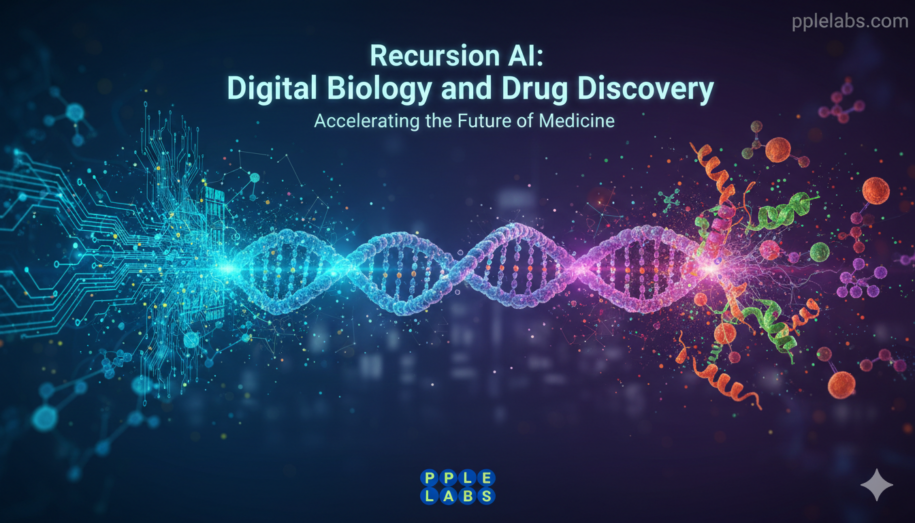
The world of medicine is undergoing a massive shift that feels more like a sci-fi movie than a traditional laboratory setting. For decades, finding a new drug was like searching for a needle in a thousand haystacks, with scientists making educated guesses and hoping for the best. Enter Recursion AI, a powerhouse in the tech-bio sector that is turning the “guesswork” of biology into a searchable, digital map. By 2026, the integration of artificial intelligence and automated biology has moved from a trendy buzzword to the very engine driving precision medicine.
1. The Rise of the Recursion OS in Modern Medicine
Before we dive into the complex science, let’s talk about the brain behind the operation: the Recursion Operating System (OS). This isn’t just a piece of software; it’s a massive, integrated loop that connects digital simulations with physical experiments. Traditionally, if a scientist wanted to test a drug, they might spend months on a single hypothesis. With Recursion AI, the system runs millions of experiments every single week, generating petabytes of data that feed back into its learning models.
Imagine if you could play a game of chess where you could see every possible move your opponent might make for the next fifty turns. That is essentially what the Recursion OS does for drug discovery. It uses “phenomics”—the study of how cells look and behave—to identify patterns that the human eye would never catch. This approach is strikingly similar to how AGI in healthcare is designed to mimic human reasoning across multiple biological domains at once.
2. Digital Biology: Mapping the Unknown with Recursion AI
Biology is messy, complex, and often unpredictable. However, Recursion AI treats biology as a data problem that can be solved with enough computing power. By using “Maps of Biology,” the company can visualize how different genes and compounds interact. These maps allow researchers to find “novel targets”—hidden biological triggers for diseases that nobody knew existed.
This digital approach helps bridge the gap between massive datasets and actual patient care. It’s a concept we see elsewhere in the industry, such as how Tempus AI uses molecular profiling to map out cancer treatments. By digitizing the building blocks of life, Recursion AI allows scientists to navigate the biological “unknown” with a GPS instead of a paper map.
3. How Recursion AI Accelerates Oncology Drug Discovery
Cancer is perhaps the most adaptive and difficult “opponent” in medicine. This is where Recursion AI truly shines, particularly in the realm of precision oncology. A standout example is the development of REC-1245, a drug designed to target specific proteins in cancer cells. By using the Recursion OS, the team was able to identify this target and move toward clinical trials much faster than the industry average.
The speed is breathtaking. What usually takes four or five years can now happen in under eighteen months. This rapid pace of discovery is vital for patients who don’t have years to wait. It mirrors the efficiency seen in tools like Nabla Copilot, which automates the administrative side of medicine so doctors can focus on the actual healing. When Recursion AI handles the heavy lifting of data analysis, the path to a cure becomes much clearer.
4. The Wet-Lab Revolution: Merging AI with Physical Reality
One of the coolest things about Recursion AI is that it doesn’t just live in a computer. The company operates massive, automated “wet labs” where robots carry out the experiments designed by the AI. This creates a continuous feedback loop. The AI suggests an experiment, the robots perform it, and the results are instantly fed back to make the AI even smarter.
This synergy between the digital and the physical is the future of the tech-bio market. It’s not just about running simulations; it’s about verifying them in real-time. This level of automation is similar to the predictive power of an AI Digital Twin, which allows for the simulation of treatments on a virtual version of a patient before a single pill is ever taken. By 2026, this “industrialized” version of drug discovery is setting a new standard for the entire pharmaceutical industry.
5. Recursion AI vs. Traditional Pharma: A 2026 Market Shift
Why is everyone talking about Recursion AI instead of the old-school pharma giants? It comes down to the failure rate. In traditional drug development, about 90% of drugs fail when they finally reach human trials. That is a lot of wasted time and billions of dollars down the drain. Recursion AI aims to flip the script by using “virtual clinical trials” and high-fidelity data to ensure that only the most promising candidates ever make it to the clinic.
While giants like Eli Lilly are building their own supercomputers, Recursion’s partnership with NVIDIA and its merger with Exscientia have solidified its place as a leader. This competitive landscape is evolving fast, much like the advancements in AI Bio Security which protect the very data these companies rely on. In the race to bring the first 100% AI-designed drug to market, Recursion AI is holding a very strong hand.
Conclusion
As we look toward the remainder of 2026, it is clear that Recursion AI is more than just a biotechnology company; it is a pioneer of a new era. By treating biology as a digital language, they are uncovering secrets of the human body that remained hidden for centuries. From oncology to rare diseases, the ability to decode life through the Recursion OS is saving time, money, and most importantly, lives. The journey from a digital map to a life-saving medicine has never been shorter, and the future of “Digital Biology” is just getting started.
Would you like me to analyze the latest clinical trial readouts for Recursion’s oncology pipeline in 2026?
Unique FAQs
1. What exactly is the Recursion OS? The Recursion OS is a proprietary artificial intelligence operating system that combines automated laboratory experiments with machine learning to identify and develop new drug candidates at scale.
2. How does Recursion AI make drug discovery faster? By using automated robotics and AI-driven “Maps of Biology,” it can run millions of cellular experiments weekly, compressing the time from initial discovery to clinical trials from years to months.
3. Is Recursion AI only focused on cancer? No, while they have a strong pipeline in oncology, Recursion AI also targets rare diseases, neuroscience, and inflammatory conditions using its versatile phenomics platform.
4. What is “Digital Biology” in the context of Recursion? Digital Biology refers to the process of converting physical biological data—like images of cells—into digital datasets that AI can analyze to predict how diseases behave and how drugs will interact with them.
5. How does Recursion AI compare to companies like PathAI? While both use AI in healthcare, PathAI focuses heavily on analyzing pathology images to improve diagnosis, whereas Recursion AI uses similar imaging technology to discover and design entirely new medicines.
Leave a Reply