
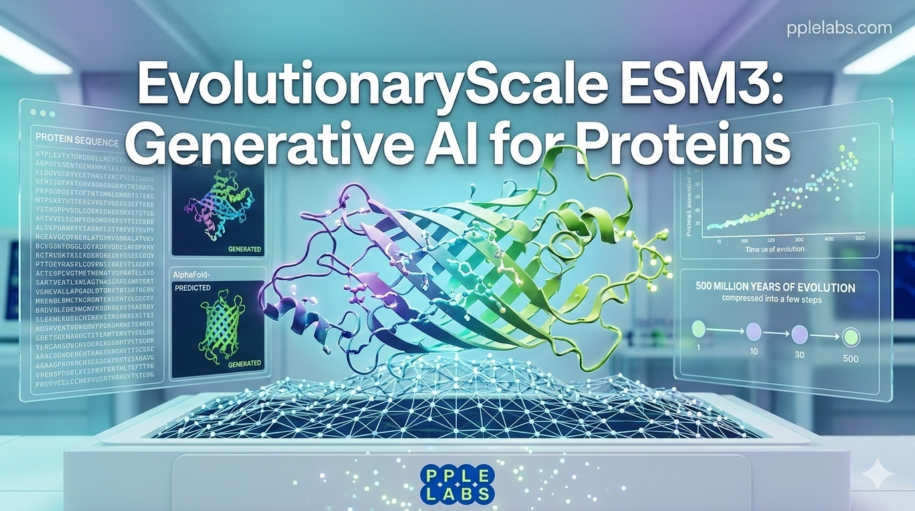
Imagine if you could sit at a computer and type out the blueprint for a new life form or a medicine that has never existed in nature. We are not talking about science fiction anymore. With the arrival of EvolutionaryScale ESM3, we are witnessing a fundamental shift in how we interact with the building blocks of life. For decades, biologists were like detectives trying to solve the mystery of how proteins fold. Now, thanks to this frontier generative model, we are becoming the architects. EvolutionaryScale ESM3 represents a monumental leap, allowing scientists to simulate 500 million years of evolution in a matter of weeks to create entire new proteins.
1. How EvolutionaryScale ESM3 Simulates 500 Million Years of Evolution
Nature is the ultimate laboratory, but it is incredibly slow. It took eons for life to develop the diverse array of proteins we see today. EvolutionaryScale ESM3 changes the game by acting as an evolutionary simulator. Instead of waiting for random mutations to happen over millennia, this model uses deep learning to navigate the vast “sequence space” of possible proteins.
Have you ever wondered why some proteins survived while others vanished? The model understands the “evolutionary sieve,” the process that filters out nonfunctional biological codes. By learning from billions of natural sequences, EvolutionaryScale ESM3 can predict which new designs will actually work in the real world. This capability is a cornerstone of Inceptive AI and its goal of programming biological software.
2. The Architecture Behind EvolutionaryScale ESM3
What makes this model so special compared to what we have seen before? It is all about how it “thinks.” Most earlier models could only look at one thing at a time, like the sequence of amino acids. However, EvolutionaryScale ESM3 is multimodal. This means it simultaneously reasons over three critical layers: sequence, structure, and function.
To achieve this, the team at EvolutionaryScale used a massive 98 billion parameter transformer. It was trained on 2.78 billion proteins using over a trillion teraflops of computing power. This scale allows the model to speak the language of biology fluently. It treats protein structures as discrete tokens, much like how a language model treats words in a sentence. This approach is similar to how the Virchow foundation model understands the language of human tissue to revolutionize digital pathology.
3. Breaking New Ground with esmGFP: A Case Study
The most famous achievement of EvolutionaryScale ESM3 so far is the creation of esmGFP. Green Fluorescent Protein (GFP) is a tool used by scientists to make cells glow so they can watch biological processes in real time. Usually, these are found in jellyfish or coral.
The researchers prompted the model to create a new version of this protein. The result was a bright fluorescent protein that is only 58% similar to anything found in nature. In the natural world, a change that significant would take half a billion years of evolution. This shows that EvolutionaryScale ESM3 is not just copying nature; it is innovating. This level of precision and speed is exactly what is needed for AI for antimicrobial resistance to stay ahead of evolving superbugs.
4. EvolutionaryScale ESM3 vs AlphaFold: Understanding the Difference
A common question is how this differs from Google DeepMind’s AlphaFold. Think of it this way: AlphaFold is like a world class translator that can take a protein sequence and tell you exactly what it looks like in 3D. It is a predictive powerhouse.
In contrast, EvolutionaryScale ESM3 is a creator. While it can predict structures, its primary job is to generate new ones. If AlphaFold is a dictionary, ESM3 is the novelist writing a new story. They work together beautifully. A scientist might use ESM3 to dream up a new enzyme and then use AlphaFold to double check its stability. This synergy is a huge part of the Recursion AI workflow, where they map the biological unknown to find new drug targets.
5. Real World Applications in Healthcare and Sustainability
The implications of this technology reach far beyond the lab. In healthcare, we are moving toward a future where we can design “biological apps” to treat diseases. For example, if a patient has a specific genetic mutation, EvolutionaryScale ESM3 could help design a custom protein to fix the issue. This is the heart of personalized medicine and treatment simulation using digital twins.
Beyond medicine, we are looking at environmental solutions. Imagine an enzyme designed specifically to eat plastic in the ocean or a protein that can capture carbon dioxide from the air with high efficiency. By exploring the protein space that nature hasn’t reached yet, we can find tools to solve our most pressing global challenges. This data driven approach mirrors the use of digital biomarkers to gain objective insights into human health.
Conclusion
We are standing at the edge of a new era. EvolutionaryScale ESM3 is not just another AI model; it is a bridge between the digital and biological worlds. By making biology programmable, we can accelerate the discovery of life saving drugs and create sustainable materials that were previously thought impossible. As we continue to refine these foundation models, the limit will no longer be what nature provides, but what our imagination can prompt.
Frequently Asked Questions (FAQs)
- What is the main purpose of EvolutionaryScale ESM3? It is a generative AI model designed to create novel proteins by reasoning over their sequence, structure, and function simultaneously.
- How does EvolutionaryScale ESM3 differ from AlphaFold? While AlphaFold focuses on predicting the structure of existing sequences, ESM3 is a generative model that can design entirely new proteins from scratch.
- What is esmGFP and why is it significant? It is a novel fluorescent protein created by the model. It is significant because it would have taken 500 million years for nature to evolve such a protein.
- Can researchers access the EvolutionaryScale ESM3 model? Yes, there is an open source version available for non commercial use, and the full 98 billion parameter model is accessible via API for partners like AWS and NVIDIA.
- How can this model help in the fight against climate change? It can be used to design specialized enzymes for carbon sequestration or plastic degradation, offering biological solutions to environmental problems.
Leave a Reply