
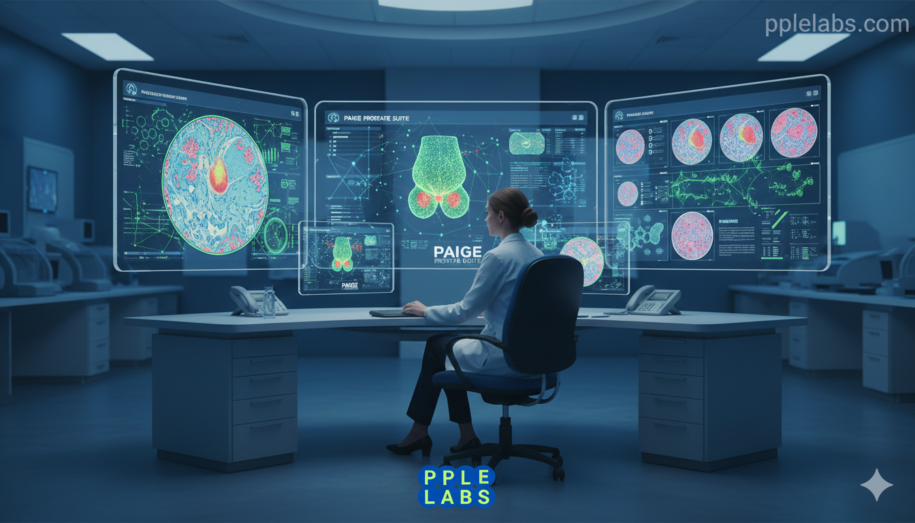
Have you ever wondered how much data is hidden inside a single sliver of human tissue? For over a century, pathologists have peered through microscopes, relying on their eyes and years of training to spot the subtle markers of disease. But as we move further into 2026, the sheer volume of cases is pushing human limits. This is where Paige AI steps in. It is not just a tool; it is a complete reimagining of how we see, understand, and treat cancer. By bringing the power of the world’s largest foundation models to the lab, Paige AI is setting a benchmark that was once thought to be pure science fiction.
1. Understanding the Power of Paige AI Digital Pathology.
The transition to Paige AI digital pathology is much like the jump from paper maps to GPS. In the old days, a pathologist would look at a physical slide and hope they did not miss a tiny cluster of malignant cells. Today, digital pathology converts those slides into massive, high resolution image files.
Paige AI takes this a step further by using advanced algorithms to scan these digital “landscapes.” It acts as a tireless partner that never gets sleepy or distracted. By focusing on the most suspicious areas, it allows doctors to work faster while actually increasing the level of scrutiny each patient receives. This marriage of technology and biology is exactly why many experts view it as the new gold standard for diagnostic labs worldwide.
2. The Virchow Model: A Giant Leap for AI in Oncology 2026.
At the heart of this revolution is a powerhouse called the Virchow foundation model. Named after the father of modern pathology, this model represents the cutting edge of AI in oncology 2026. Unlike earlier versions of AI that were only good at one specific task, Virchow is a generalist with the depth of a specialist.
How the Virchow Foundation Model Learns from Millions of Slides.
Imagine a student who has seen over 1.5 million pathology slides from thousands of different patients. That is essentially what the Virchow model has done. By training on such a massive scale, Paige AI has created a system that recognizes the “language” of human tissue. It understands the nuances of cell shapes, the architecture of tumors, and the strange patterns that signify a rare disease. This scale is what makes Paige AI so robust. It is not just guessing based on a few examples; it is drawing from a library of data that no human could ever memorize in a lifetime.
Improving Cancer Diagnostic Accuracy Across Multiple Tissue Types.
One of the biggest hurdles in medicine is the “rare” case. If a doctor only sees a specific type of cancer once every five years, they might miss the early signs. However, because Paige AI has seen everything from common breast cancer to the rarest sarcomas, it maintains a high level of accuracy across the board. This capability is vital for advancing precision oncology because it ensures that every patient, regardless of their condition, gets an expert level second opinion from the start.
3. Real World Impact: The Paige Prostate Suite Review.
Theory is great, but does it work in the clinic? The answer is a resounding yes. The Paige Prostate Suite was the first of its kind to receive FDA clearance, marking a historic moment for the industry. This suite is designed to help identify foci that are suspicious for cancer in prostate biopsies, which are notoriously difficult to read.
When we look at a Paige Prostate Suite review, the data is impressive. It can reduce diagnostic errors by up to 70 percent. Think about that for a second. That is thousands of people getting the right diagnosis earlier, which often means the difference between a simple procedure and a life altering battle. It also helps labs manage their diagnostic imaging workloads more effectively by flagging the most urgent cases for immediate review.
4. Integrating Paige AI into the Digital Pathology Workflow.
A common fear among medical professionals is that new tech will be hard to use. Fortunately, Paige AI is designed to fit right into the existing digital pathology workflow. It does not require a complete overhaul of the lab. Instead, it works with the scanners and software pathologists already use.
This “plug and play” nature is essential for widespread adoption. By automating the routine parts of the job—like measuring tumor size or counting cells—Paige AI frees up the pathologist to focus on the high level decision making. It is like having a co-pilot who handles the navigation so the captain can focus on flying the plane. For more insights on how these technologies are evolving, check out how Cleerly AI is changing heart health with similar predictive power.
5. Why Paige AI represents the Future of Precision Medicine.
As we look toward the future, the goal is to treat the patient, not just the disease. Paige AI is instrumental here because it can identify molecular biomarkers directly from standard tissue slides. Usually, finding these markers requires expensive and time consuming genetic testing.
By using Paige AI, doctors can get these insights in a fraction of the time. This speed allows for truly personalized medicine, where the treatment plan is tailored to the specific genetic makeup of the tumor. It is a shift from “one size fits all” to a targeted strike. As WHO standards for 2026 continue to emphasize digital and molecular integration, tools like Paige AI are becoming indispensable. The synergy between human intuition and machine precision is creating a safer, faster, and more accurate healthcare system for everyone.
Conclusion
In the end, Paige AI is more than just a software update for the lab. It is a fundamental shift in how we approach one of the greatest challenges in human health. By combining the massive data processing power of the Virchow model with the clinical precision of the Paige Prostate Suite, we are entering an era where cancer has fewer places to hide. Pathologists are no longer working alone; they are empowered by a digital partner that sees the invisible. As we continue to refine these tools, the dream of 100 percent diagnostic accuracy moves closer to reality every single day.
FAQs
1. Is Paige AI replacing human pathologists? Not at all. Think of it as a highly advanced assistant. It handles the repetitive, data heavy tasks, allowing the human pathologist to make the final, critical diagnostic decisions with more confidence.
2. What makes the Virchow model so special compared to other AI? Most AI models are “narrow,” meaning they are only trained for one specific cancer. The Virchow model is a foundation model trained on 1.5 million slides, giving it the ability to understand almost any tissue type.
3. Has Paige AI received official medical clearance? Yes, the Paige Prostate Suite was the first AI based pathology software to receive FDA de novo authorization, proving its safety and effectiveness in a clinical setting.
4. How does Paige AI improve the speed of cancer diagnosis? By automatically flagging suspicious areas on a slide, it allows pathologists to focus on the most critical parts of a case immediately, significantly reducing the time a patient has to wait for results.
5. Can Paige AI help with rare types of cancer? Yes, because it was trained on an unprecedented variety of tissue samples, it is exceptionally good at identifying patterns in rare cancers that a human might only see once in a career.
Leave a Reply