
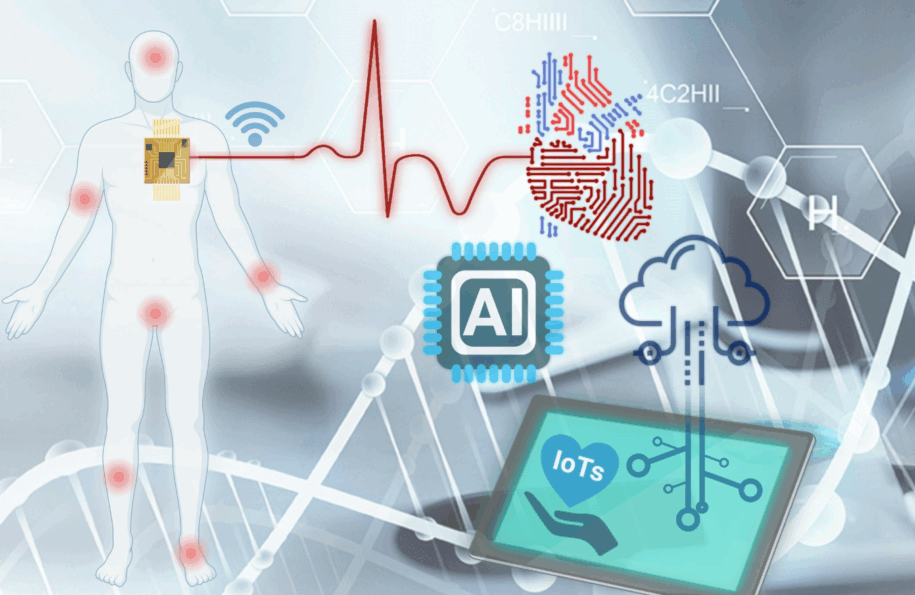
We’ve all been there: sitting in a doctor’s office, trying to accurately remember how you felt over the last month. Did you sleep poorly five nights or ten? Was your pain level a six or a seven? Healthcare, for so long, has relied on these subjective, patchy snapshots of our lives. But what if there was a way to capture the full, continuous movie of your health? The breakthrough lies in the powerful combination of Digital Biomarkers & AI. This isn’t science fiction anymore; it’s a seismic shift toward objective health measures, drawn from the passive data we generate every single day. We’re finally moving beyond guesswork and into the realm of true, data-driven understanding of the human body.
1. The Revolution of Objective Health Measurement with Digital Biomarkers & AI
It’s time to move the diagnostic needle beyond the annual checkup. We need tools that can tell us when something is changing before we even realize it ourselves.
1.1. What Exactly are Digital Biomarkers?
So, what are we talking about when we say “digital biomarkers”? Think of them as the next generation of your traditional blood pressure reading or cholesterol level. A traditional biomarker is a measure of a biological process. A Digital Biomarker is a quantifiable indicator of a physiological or behavioral state derived from consumer-facing or clinical digital devices. This includes smartphones, wearable sensors, and even ambient sensors in your home. These devices constantly collect data on your gait speed, sleep patterns, heart rate variability, voice cadence, and typing speed. When researchers validate these signals against a real clinical condition, they become bona fide Digital Biomarkers. Understanding the formal definition of digital biomarkers by industry groups helps us appreciate their clinical weight.
1.2. Moving Beyond Subjective Reports: The Need for Objective Health Measures
Why do we need this shift? Because subjective reports are inherently flawed. People forget, they exaggerate, or they downplay symptoms based on how they think they should feel. Imagine trying to track the progression of a neurodegenerative disease based only on how a patient self-reports their tremor severity once a month. Now, picture a wrist-worn device continuously measuring that tremor hundreds of times a day. The latter provides objective health measures, unbiased, continuous, and high-fidelity data that truly reflects the patient’s real-world state. This data is the lifeblood of precision medicine, allowing us to see subtle changes that would be invisible in a one-off clinic visit. This is how we start Advancing precision oncology and other complex fields.
2. How Passive Data Monitoring Fuels Digital Biomarkers & AI
The magic of this field is that the best data is the data you don’t even know you’re giving. This concept is called “passive data monitoring.”
2.1. The Role of Wearable Sensors and Remote Patient Monitoring (RPM)
The explosion of smartwatches and fitness trackers hasn’t just been a boon for personal wellness; it’s become a powerful engine for medical research. These are the tools of Remote Patient Monitoring (RPM). Wearable sensors are non-invasive and can collect a huge volume of continuous health data streams without interrupting a person’s life. This is the ultimate form of passive data. Patients simply wear their device, and data on heart rhythms, activity levels, and sleep quality flows continuously to the cloud. This constant stream gives doctors and researchers a granular view of health outside the clinic walls, providing incredible value for both chronic disease management and clinical trials. For more on this revolution, check out the future of remote patient monitoring.
2.2. The Power of Ambient and Behavioral Data Streams
It’s not just about what’s on your wrist. Digital Biomarkers & AI also rely on ambient data, data collected from your environment or your normal digital interactions. Think about how you interact with your smartphone. Your typing speed, scrolling patterns, or even the subtle changes in your voice captured during a call can become incredibly insightful digital biomarkers. Changes in these behaviors can subtly hint at cognitive decline, mood shifts, or fatigue. This allows for a truly multi-modal data integration, bringing together physiology (heart rate) and behavior (sleep, movement) into one cohesive picture. The regulatory guidance on remote monitoring devices continues to evolve as these technologies become more mainstream.
3. Digital Biomarkers & AI in Action: Driving Precision Health
This isn’t just about collecting a lot of data; it’s about what we do with it. The key is the ‘AI’ part of Digital Biomarkers & AI.
3.1. Validating Digital Biomarkers for Clinical Trials
Before a digital measure can be used to make a real medical decision, it must be rigorously tested and validated. This process is crucial, especially in clinical trials, where we need to know if a new drug is actually working. Traditional endpoints are often too slow or subjective. Digital Biomarkers offer the chance to create highly sensitive, objective endpoints. Instead of asking a Parkinson’s patient if they feel better, a Digital Biomarker & AI system can measure a statistically significant decrease in tremor amplitude and frequency. This dramatically increases the power and efficiency of studies, which is essential for validating AI-powered diagnostics. This work is key to making sure the data truly reflects the patient experience. A landmark study on passive monitoring in depression showcases the potential of this data in mental health, too.
3.2. AI: The Engine for Continuous Vitals Monitoring and Early Disease Detection
You simply cannot analyze the overwhelming volume of continuous, passive data manually. That’s where Artificial Intelligence steps in. AI is the engine that processes the noise and finds the signal. It looks at your walking pattern, heart rate variability, and sleep quality, and it can detect minute changes that collectively indicate the onset of an illness days or even weeks before you notice symptoms. This approach, often called AI Phenotyping, can spot the subtle shifts that predict flu, heart failure exacerbation, or a mental health crisis. For instance, an AI model could learn that a one percent drop in activity coupled with a shift in nighttime breathing rate is a strong predictor of a hospital readmission risk. Learning how to manage and integrating multi-modal data is a continuous challenge that AI helps us overcome.
4. Challenges and the Path Forward for Digital Biomarkers & AI
While the potential is enormous, we need to acknowledge the hurdles. First and foremost, there are questions of data privacy and security. Who owns this incredibly sensitive, continuous health data, and how do we ensure it’s protected? Furthermore, we need to establish standardized protocols. Different devices measure things slightly differently, which makes comparing data across studies difficult.
Another significant challenge is ensuring equity. As the growing market for wearable sensors expands, we must prevent the creation of a two-tiered system where only those who can afford the technology benefit from Precision Health. The path forward requires a unified approach involving technology developers, clinicians, and regulatory bodies like the FDA. We need to focus on ethical AI in healthcare to build public trust and ensure that these powerful new tools benefit everyone, driving us towards a world where personalized, preventative medicine is the standard, not the exception. The future of health is continuous, objective, and powered by Digital Biomarkers & AI.
Conclusion
The convergence of Digital Biomarkers & AI represents one of the most exciting and consequential shifts in modern medicine. By leveraging passive data from the devices we already use, we gain objective, high-resolution insights into human health that were previously impossible to achieve. This move from subjective snapshots to a continuous health movie is redefining everything from drug development in clinical trials to the early, proactive detection of disease in a patient’s daily life. While challenges around data standards and privacy persist, the foundation for true Precision Health has been laid. We are entering an era where your health data is constantly working for you, ushering in a healthier future for all. For more information on this field, read about the importance of continuous health data streams and analytics.
Frequently Asked Questions (FAQs)
1. How is a Digital Biomarker different from a simple wearable fitness metric?
A simple wearable metric, like your step count, is raw data. A Digital Biomarker is that raw data, or a complex algorithm derived from it, that has been rigorously validated and shown to correlate with a clinically defined health or disease state. It’s the difference between a simple blood sugar reading and a clinically proven measure of HBA1c.
2. What are some examples of passive data used in Digital Biomarkers & AI?
Passive data includes anything automatically collected without conscious effort from the user. Examples are: continuous heart rate variability while you sleep, minute changes in walking speed (gait) from a phone’s accelerometer, voice patterns/cadence captured during a phone call, and typing speed/error rate on a keyboard.
3. Is “Digital Biomarkers & AI” mainly used for sick patients or also for healthy people?
It is highly relevant for both! For sick patients, it enables Remote Patient Monitoring (RPM) and continuous disease tracking. For healthy individuals, it is crucial for preventative medicine and wellness, allowing AI to detect subtle shifts that signal the pre-symptomatic phase of a potential illness, enabling much earlier intervention.
4. What is the biggest barrier to widespread adoption of Digital Biomarkers in clinics?
The primary barrier is establishing regulatory and clinical standards. Since data comes from many different devices, clinicians and regulators need standardized thresholds, validation methodologies, and interoperability protocols to ensure the data is reliable, trustworthy, and actionable across all healthcare systems.
5. How does AI specifically help in the context of Digital Biomarkers?
AI is indispensable because it can process the massive, continuous, and complex streams of multi-modal passive data that human analysts cannot. It identifies patterns, creates predictive models, and correlates subtle, simultaneous changes across different data streams (e.g., sleep, activity, and voice) to accurately and objectively determine a person’s health status.
Leave a Reply