Building powerful artificial intelligence models for medical diagnostics always brings up a frustrating paradox. To train an algorithm that accurately spots rare conditions, engineers need access to millions of diverse patient data points. Yet, those exact data points are safely tucked behind strict hospital firewalls, protected by tight privacy regulations. Moving that sensitive information to a central cloud server introduces massive compliance risks, steep data storage fees, and the ever present threat of cybersecurity breaches.
What if the training process could go to the data instead of pulling the data to the training process? This is where FedML healthcare steps in. By leveraging a decentralized machine learning platform, hospital networks can now collaborate on model training without ever sharing or consolidating sensitive patient records. This shift changes the entire playbook for how healthcare groups build, refine, and deploy predictive tools.
1. What is FedML Healthcare and How Does It Transform Clinical AI?
To understand how FedML healthcare changes the game, it helps to look at how traditional clinical AI projects fall short. Usually, a tech team asks multiple hospital networks to sign complex legal agreements, package their medical images, and send them to a single server. In contrast, FedML healthcare leaves every file right where it belongs: inside the home facility.
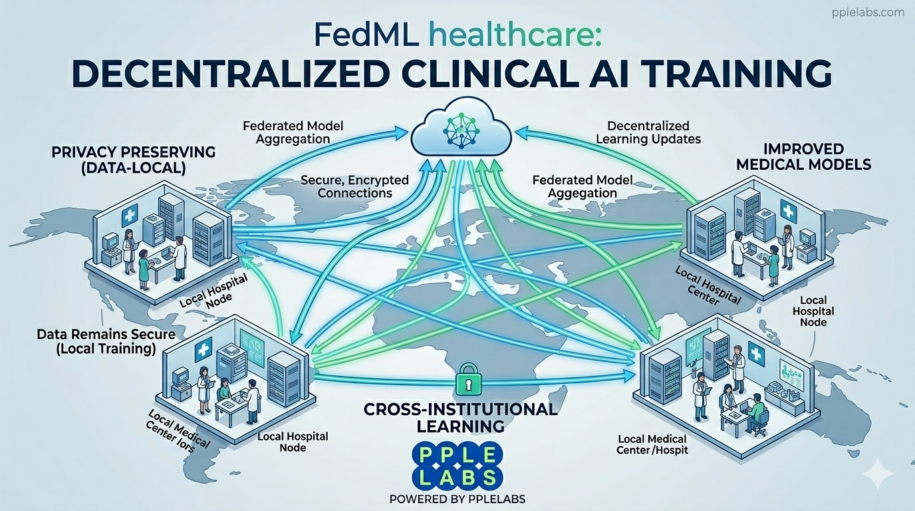
The architecture relies on a specialized orchestration method. The central server maintains a master AI model, which it broadcasts to every participating hospital node. Each local facility runs training cycles on its own internal machines using local data. Once the local training run finishes, the node sends back only the mathematical model updates, not the patient records.
This model ensures that data sovereignty stays intact. Hospital administrators keep complete control over their physical storage arrays, while still gaining the benefits of a smarter global model.
2. Core Pillars of Privacy Preserving AI in Modern Healthcare Ecosystems
Implementing privacy preserving AI requires a foundation that protects records against both external hacks and internal leaks. FedML healthcare addresses this by using advanced cryptographic protocols that ensure absolute security during the training process.
The platform relies heavily on secure aggregation techniques. When various hospital networks send their local mathematical updates back to the primary server, those updates are mixed together using advanced encryption methods. The central server can read the combined community trend, but it cannot isolate or reverse engineer the specific data contribution of any single hospital node.
This setup helps medical networks bypass the logistical headaches that slow down typical multi institutional research projects. It gives legal teams peace of mind because no protected health information ever crosses corporate borders. By making local data anonymous at the source, healthcare providers can build highly effective diagnostic software that naturally matches global compliance standards. This security approach mirrors the predictive advancements detailed in our look at the AI and machine learning personalized healthcare revolution.
3. Case Study: Training Cross Institutional Oncology Detection Models Safely Using FedML Infrastructure
Oncology research provides an excellent real world example of decentralized training in action. Training cross institutional oncology detection models safely using FedML infrastructure allows cancer centers around the world to pool their insights without risking patient confidentiality.
Consider a group of diverse medical centers trying to build an algorithm to identify rare pancreatic tumors. A single hospital might only see a handful of these cases each year, which is not enough data to build a reliable neural network. By using FedML healthcare infrastructure, multiple international centers can train a shared model together.
[Oncology Network] -> Shared FedML Framework -> Unified Diagnostic Model
– Center 1: Rare Pancreatic Scans (Local Only)
– Center 2: Early Stage Biomarkers (Local Only)
– Center 3: Targeted Histology Slides (Local Only)
This collaborative approach exposes the model to thousands of unique tumor variations, imaging setups, and patient profiles. The result is a highly accurate diagnostic tool that can spot early stage malignancies with precision, completely avoiding the data sharing hurdles that usually stall clinical trials. For a look at how specialized models are transforming other areas of medicine through automated workflows, check out our guide on agentic AI healthcare solutions.
4. How FedML Healthcare Compares to Traditional Centralized MLOps Frameworks
The differences between FedML healthcare and centralized Machine Learning Operations (MLOps) frameworks come down to data ownership and operational overhead. Centralized systems require massive engineering pipelines to ingest, clean, and store files from various sources in a single cloud repository.
| Metric | Centralized MLOps | FedML Healthcare |
| Data Location | Consolidated Cloud Server | Local Hospital Storage |
| Network Cost | Extremely High Upload Fees | Minimal Update Exchange |
| Security Risk | Single Point of Data Failure | Distributed Local Nodes |
| Compliance | Requires Heavy Legal Approvals | Built In Privacy Architecture |
Centralized storage creates a single, attractive target for hackers. A single security breach can expose millions of patient records at once. FedML healthcare eliminates this vulnerability by distributing the footprint. Because there is no massive cloud repository to compromise, the risk of a widespread clinical data leak drops sharply.
Furthermore, keeping data local removes the ongoing costs of transferring petabytes of medical imaging files over commercial networks. This setup lets teams allocate their budgets toward refining algorithms rather than paying for cloud storage space.
5. The Future Landscape of Federated Learning in Healthcare 2026
As we move through 2026, the global market for decentralized medical training tools is seeing rapid adoption. Industry reports from Astute Analytica on federated learning trends point to a strong shift toward on premises, privacy preserving AI platforms across major health systems. This evolution is giving rise to a new wave of automated digital assistants that run securely within clinical environments. You can explore how these interactive voice interfaces are changing patient interactions in our overview of Hippocratic AI empathic voice agents.
At the same time, leading research published in the Annual Review of Biomedical Engineering on federated deployment emphasizes that decentralized networks are essential for building fair, unbiased AI. Because different clinics serve varied demographics, training algorithms across multiple decentralized nodes ensures that the resulting tools work effectively for patients from all backgrounds.
6. Conclusion: Unlocking Global Medical Insights While Honoring Local Privacy
The old approach of centralizing medical data to train AI models is hitting a wall of regulatory, financial, and security challenges. FedML healthcare offers a proven alternative that respects data sovereignty while enabling deep, cross institutional collaboration. By moving the training code to the data instead of moving patient records to the cloud, healthcare systems can build highly accurate diagnostic tools without compromising security. Embracing this decentralized approach allows the medical community to accelerate research, improve patient outcomes, and maintain absolute privacy.
Frequently Asked Questions (FAQs)
1. Does FedML healthcare require hospitals to share raw medical records?
No, the platform ensures that raw patient data never leaves the hospital firewall. Only encrypted mathematical model adjustments are shared with the central coordinating server.
2. How does training cross institutional oncology detection models safely using FedML infrastructure help with rare diseases?
Rare diseases are difficult to model because individual clinics see very few cases. This framework allows multiple global hospitals to train a shared model collectively, providing the necessary data diversity without moving sensitive files.
3. What keeps the central server from reversing the model updates to see patient data?
The framework uses secure cryptographic aggregation. This blends the updates from all participating hospitals together, making it impossible for the central coordinator to isolate or decrypt the data patterns of any single facility.
4. Is federated learning in healthcare 2026 compliant with international data privacy laws?
Yes, because patient records remain local and are never transferred across regional or national borders, this approach naturally aligns with strict data privacy guidelines worldwide.
5. How does this setup reduce overall cloud infrastructure costs for hospital groups?
It eliminates the need to upload, store, and manage massive datasets on a centralized cloud server, significantly lowering bandwidth expenses and data hosting fees.
Leave a Reply