
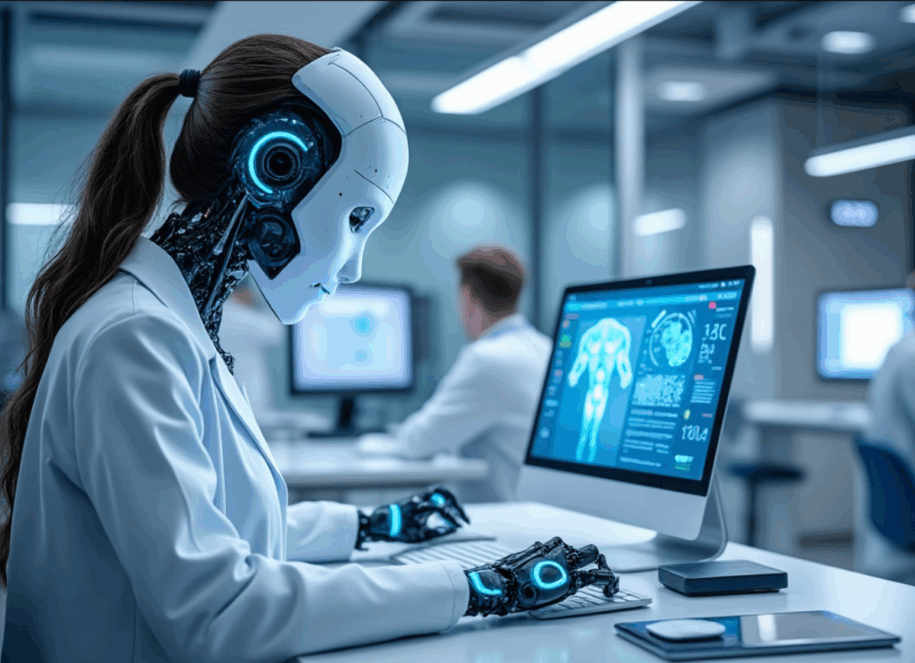
The Internet of Medical Things (IoMT) has transformed healthcare, ushering in an era of real-time patient monitoring, remote diagnostics, and smart devices that save lives. However, this same connectivity has introduced a new frontier for cyber threats. Every connected device, from smart infusion pumps to remote patient monitors, is a potential entry point for hackers. The consequences of a breach here are far more severe than in typical IT environments; they extend beyond data theft to potential patient harm and even fatality. This urgent need for advanced protection is driving the adoption of Artificial Intelligence (AI). Traditional, signature-based defenses are no match for sophisticated, low-and-slow attacks targeting medical devices. The future of healthcare cybersecurity rests on Securing IoMT with AI: Behavioral analytics for medical device defense, which provides a proactive, pattern-based approach to security.
1. The IoMT Vulnerability Crisis and the AI Solution
IoMT devices pose unique security challenges that general IT solutions cannot solve. Many devices run on legacy operating systems, lack basic security protocols, and cannot be patched or updated frequently due to FDA regulations or clinical uptime requirements. These limitations create a fertile ground for cyberattacks. The global IoMT market is projected to skyrocket, with adoption increasing daily, making the threat landscape broader and more dangerous. Industry reports consistently show the healthcare sector facing the highest average cost for data breach recovery, with ransomware and device vulnerabilities remaining top concerns.
1.1. Why Traditional Security Fails at Securing IoMT with AI: Behavioral analytics for medical device defense
Traditional security systems rely on recognizing the signature of a known threat. They function well against malware seen before but are blind to zero-day attacks or the subtle, unauthorized lateral movement of a hacker who has compromised a device. This is particularly problematic in a hospital environment where a device’s “normal” behavior can be complex and varied.
- 🚫 Blind Spots: Inability to detect novel attacks or insider threats operating within seemingly legitimate credentials.
- ⏳ Slow Response: Relies on security updates and patches, leaving large windows of vulnerability for unpatchable legacy devices.
- 🚨 High False Positives: Simple rule-based alerts often generate too much noise, causing security teams to miss critical alerts.
This is precisely where behavioral analytics, powered by AI, steps in. It shifts the defensive strategy from checking for known bad signatures to detecting abnormal behavior. This advanced approach is central to Securing IoMT with AI: Behavioral analytics for medical device defense.
2. Defining Behavioral Analytics for IoMT Cybersecurity
Behavioral analytics in cybersecurity is a data-driven technique that uses machine learning (ML) to analyze the normal tendencies and activity patterns of users, endpoints, and devices. In the context of IoMT, it focuses specifically on the communication and operational patterns of connected medical equipment.
2.1. Establishing a Behavioral Baseline: The Foundation of Device Defense
The first step in Securing IoMT with AI: Behavioral analytics for medical device defense is establishing a precise behavioral baseline for every device. . The AI engine monitors each device for a defined period, collecting data on:
- Communication Patterns: Which servers, IP addresses, and geographical locations the device normally connects to.
- Data Volume: The usual amount of data transferred and the time of day the transfers occur.
- Protocol Usage: Which communication protocols (e.g., HL7, MQTT, DICOM) are standard for its operation.
- Operational Context: The typical operating hours and resource utilization (e.g., CPU load).
2.2. Detecting Anomalies: How AI Finds the Intruder
Once the baseline is set, the AI continuously compares real-time activity against that profile. Any deviation from the established norm is flagged as an anomaly. The goal is to detect subtle shifts that signal compromise, such as:
- Unusual Access Time: An MRI machine attempting to connect to an external server at 3 AM when it is usually dormant.
- Protocol Deviation: A patient monitor suddenly initiating a connection using a non-standard protocol like FTP.
- Lateral Movement: A compromised infusion pump attempting to scan or communicate with other devices on a separate clinical network segment.
This ability to spot the subtle signal in the massive noise of network traffic is the defining advantage of Securing IoMT with AI: Behavioral analytics for medical device defense.
3. The Mechanisms of IoMT Device Defense with AI
The effectiveness of AI in this space stems from its ability to analyze massive, disparate data sets in real-time, far surpassing human capability.
3.1. User and Entity Behavior Analytics (UEBA)
In IoMT, UEBA (User and Entity Behavior Analytics) is extended beyond human users to include devices. This means the system tracks the behavior of the device itself (the entity) and the users interacting with it. By integrating data from network traffic, system logs, and security feeds, the UEBA system builds a holistic view. If an authorized user logs into a device but then initiates a series of non-clinical data exfiltration commands, the UEBA model detects the compromise by analyzing the shift in the user’s historical behavior. This dual-focus greatly enhances the efficacy of Securing IoMT with AI: Behavioral analytics for medical device defense.
3.2. Predictive Modeling and Risk Scoring
AI doesn’t just react; it predicts. By applying machine learning models (like Random Forest or clustering algorithms), security platforms can analyze the collective data of similar devices and anticipate threats based on emerging patterns. Anomalies are assigned a risk score, factoring in the sensitivity of the device (e.g., a life-support machine scores higher than a digital signage monitor) and the severity of the deviation. This crucial prioritization ensures security teams focus their limited resources on the highest-impact threats first. This focused approach is a cornerstone of modern cybersecurity risk mitigation. For more on managing financial risks associated with regulatory compliance, you can read our detailed post on minimizing data risks: Healthcare Startups: Minimizing HIPAA and GDPR Risks and Cost (anchor text is descriptive).
4. Implementation and Operational Challenges
While the benefits are clear, successfully implementing behavioral analytics for IoMT requires overcoming specific hurdles, particularly in a complex hospital IT environment.
4.1. Data Integration and Resource Constraints
IoMT environments are heterogeneous; devices use dozens of different protocols, operating systems, and connectivity methods. Integrating data from all these sources into a single analytic engine is a significant engineering task. Furthermore, many medical devices are resource-constrained and cannot host complex security agents. The behavioral analytics solution must be deployed at the network level, requiring sophisticated visibility tools. Workflow automation, often built using platforms like n8n, can be instrumental in stitching together these disparate data streams for efficient analysis. For an example of how automated workflows benefit healthcare, consider our analysis of streamlined operations: The Impact of Workflow Automation on Behavioral Health Services (relevant to system coordination).
4.2. The Regulatory and Ethical Landscape
Securing IoMT with AI: Behavioral analytics for medical device defense must always comply with patient data privacy laws like HIPAA. The analysis must be non-intrusive and transparent. Any security solution must be validated to ensure it does not interfere with the clinical function of the medical device, which is a key concern for the FDA and healthcare providers. It requires a delicate balance between security and clinical function, often demanding specialized expertise in healthcare operations. For deeper insights into AI’s role in future healthcare operations, see: AGI in Healthcare: The Future of Medicine (ties in AI technology with clinical operations).
5. The Future of Medical Device Defense
The future of Securing IoMT with AI: Behavioral analytics for medical device defense points toward fully autonomous, adaptive systems. These systems will not only detect anomalies but also automatically segment or quarantine a suspected device without human intervention, all while minimizing disruption to patient care. . This move from detection to automated response will be the final step in creating a truly resilient and secure healthcare ecosystem. This proactive security posture is a necessity; without it, the promise of IoMT is continually jeopardized by the reality of cyber threats.
The integration of advanced AI and behavioral analytics is no longer optional, it is essential for protecting patient data and, more importantly, patient lives. The shift to understanding and predicting device behavior is the most powerful defense against evolving cyber threats in the IoMT space.
Conclusion
The digital transformation of healthcare, fueled by the IoMT, presents incredible opportunities alongside unprecedented risks. Relying solely on legacy defenses is a path toward inevitable compromise. Securing IoMT with AI: Behavioral analytics for medical device defense offers the proactive, intelligent solution required to protect this critical infrastructure. By establishing normal device behaviors and instantly flagging deviations, AI ensures continuous operation, HIPAA compliance, and, most critically, patient safety. Adopting this strategy today is not just a cybersecurity initiative, it is a commitment to the highest standard of modern patient care.
Frequently Asked Questions (FAQs)
What is IoMT behavioral analytics in simple terms?
IoMT behavioral analytics is a security approach that uses AI and machine learning to determine what “normal” activity looks like for a medical device (e.g., a monitor or pump). It then instantly flags any activity, such as connecting to an unusual server or transferring too much data, that deviates from that learned normal behavior, indicating a potential attack or compromise.
How is IoMT security different from traditional corporate IT security?
IoMT security is critical because it involves patient safety and life-sustaining devices. Unlike corporate laptops, many medical devices cannot be regularly patched or rebooted. They also handle highly sensitive data (PHI). Traditional security focuses on endpoints; IoMT security must focus on behavior due to the devices’ unique operational and regulatory constraints.
Can AI-driven behavioral analytics stop a zero-day attack?
Yes, this is one of its core strengths. Since zero-day attacks (unknown threats) have no known signature, traditional antivirus is useless. Behavioral analytics works by detecting the effect of the attack, the anomalous behavior the malicious code causes on the device or network, thereby stopping the threat before it is officially identified.
Does behavioral analytics interfere with the functioning of the medical devices?
No, the analysis is generally conducted non-intrusively at the network level (by monitoring traffic metadata) rather than on the resource-constrained device itself. The goal is to detect threats without affecting the device’s operational stability, which is paramount for patient care and regulatory compliance.
What authoritative sources provide further reading on behavioral cybersecurity?
For detailed, authoritative information on the subject, consult resources from major security research institutions. The MITRE ATT&CK Framework provides comprehensive knowledge on adversary tactics, and research from organizations like CrowdStrike and IBM offers excellent deep dives into the mechanics and applications of User and Entity Behavior Analytics (UEBA). For instance, the CrowdStrike Falcon Platform provides detailed explanations of how behavioral analytics is leveraged in modern threat detection: CrowdStrike’s overview on behavioral analytics. For statistics on the growing market and vulnerabilities, a trusted source like Fortune Business Insights is recommended: IoMT Market Size and Growth.
Leave a Reply