
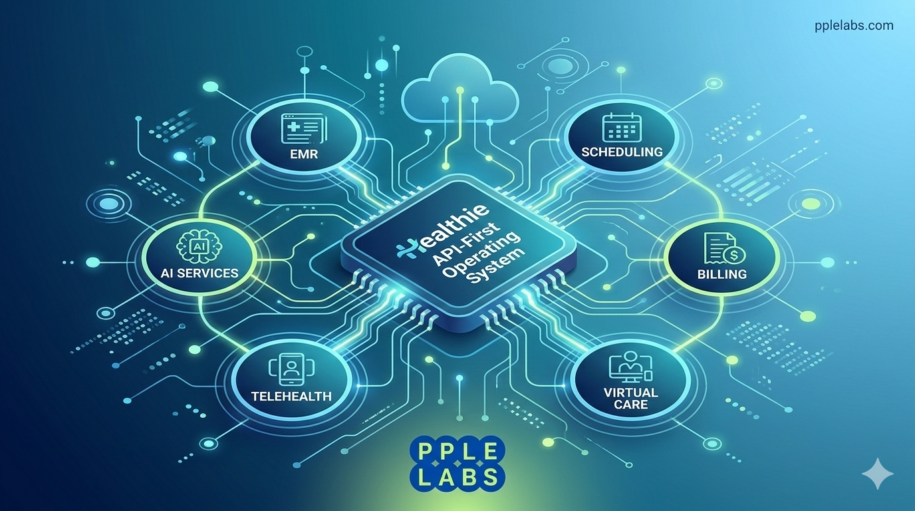
Have you ever tried to build a high-growth healthcare app only to be slowed down by a clunky, old-school database? It feels like trying to run a marathon in hiking boots. The Healthie API-First Operating System is the lightweight, high-performance sneaker the industry has been waiting for. It is not just another piece of software; it is a fundamental shift in how we think about medical data. Instead of being trapped in a pre-packaged box, developers now have the keys to a modular engine that can be customized to fit any vision.
1. What Exactly is the Healthie API-First Operating System?
Think of the Healthie API-First Operating System as the “Stripe” of healthcare. Just as Stripe made it easy to accept payments without building a bank, this platform makes it easy to deliver care without building a hospital’s IT department. It provides the essential infrastructure—EMR, scheduling, billing, and engagement—via a robust GraphQL API.
This means you can build your own beautiful, branded interface while the Healthie API-First Operating System handles the “heavy lifting” in the background. Whether you are launching a virtual-first clinic or a complex AI diagnostic tool, you get a production-ready backend on day one. It is about speed, flexibility, and moving away from the “one size fits all” approach of the past decade.
2. Core Components of the Healthie API-First Operating System Architecture
To understand why this is a game-changer, we have to look under the hood. The system is built on a “headless” philosophy. This means the backend (where the data lives) is separate from the frontend (what the user sees).
2.1. The Headless EMR for Custom Patient Journeys
A major part of the Healthie API-First Operating System is its headless Electronic Medical Record (EMR). Traditional EMRs force doctors to follow a specific path. With a headless approach, you can design a patient journey that feels natural for your specific specialty. If you are building a nutrition-focused clinic, your interface will look completely different from a mental health platform, even though they both use the same powerful backend. This level of clinical workflow augmentation is what allows modern startups to stand out.
2.2. Integrated Scheduling and Billing Engine
Managing calendars across multiple time zones is a nightmare. The Healthie API-First Operating System simplifies this with a scheduling engine that talks directly to your billing. When a patient books a slot, the system can automatically verify insurance or process a credit card payment. This reduces the administrative “friction” that often leads to burnout. By using a digital front door approach, you ensure that every patient interaction is smooth and automated from the very first click.
3. Why AI Startups Need a Healthie API-First Operating System
We are living in the age of intelligence. If your data is locked in a silo, your AI is useless. The Healthie API-First Operating System is designed specifically to feed modern algorithms the structured data they crave.
3.1. Powering Ambient Scribes and Predictive Tools
Imagine an AI scribe that listens to a doctor and automatically updates the patient’s record. This is much easier to build when you have a Healthie API-First Operating System that offers deep API access. You can pipe audio data into an LLM and then use the API to push the summary back into the EMR. This is similar to how Nabla Copilot operates, creating rapid clinical notes that save hours of paperwork every single day.
3.2. Automating Clinical Workflows with GraphQL
The use of GraphQL is a masterstroke. Unlike older REST APIs, GraphQL allows you to ask for exactly the data you need and nothing more. This makes your app faster and more efficient. When you combine this with agentic AI healthcare solutions, you can create digital agents that monitor patient vitals and trigger alerts when something looks off. The Healthie API-First Operating System provides the “nervous system” for these intelligent agents to act upon.

4. Scaling Virtual Care with the Healthie API-First Operating System
Growth is the goal for any startup, but scaling in healthcare is notoriously difficult. The Healthie API-First Operating System is built to handle the load. Whether you have 100 patients or 10 million, the infrastructure remains stable. It supports hybrid care models that blend in-person visits with virtual check-ins, ensuring that care is never fragmented.
Because it is a developer-first platform, you can constantly iterate on your product. You don’t have to wait for a legacy vendor to release a new feature. You can build it yourself using the documentation provided by Healthie. This agility is why so many high-growth clinics are making the switch.
5. Security and Compliance: The Foundation of the Healthie API-First Operating System
You cannot talk about healthcare without talking about security. The Healthie API-First Operating System is HIPAA and SOC 2 compliant right out of the box. This saves startups months of legal hurdles and thousands of dollars in audit fees.
Security is a continuous process, not a one-time event. Many organizations pair their infrastructure with tools like Vanta AI Trust to ensure they are always audit-ready. By building on the Healthie API-First Operating System, you are inheriting a fortress-like security posture that protects both your business and your patients.
6. Conclusion
The Healthie API-First Operating System represents the future of medical technology. It moves us away from the era of “dumb” databases and into the era of programmable, intelligent healthcare. By providing a flexible, headless foundation, it empowers developers to build the next generation of AI-driven clinics. If you want to move fast, stay compliant, and deliver an exceptional patient experience, building on an API-first foundation is the only way forward.
Frequently Asked Questions (FAQs)
1. What makes the Healthie API-First Operating System different from a regular EMR? A regular EMR is a finished product with a fixed interface. The Healthie API-First Operating System is a platform that gives you the backend tools to build your own custom interface and workflows.
2. Can I use the Healthie API-First Operating System for a physical clinic? Yes. While it is popular for virtual-first companies, it is fully capable of managing in-person scheduling, room management, and traditional insurance billing for physical locations.
3. Does the Healthie API-First Operating System support insurance billing? Absolutely. It has a built-in billing engine that handles everything from superbills to direct CMS-1500 submissions and payment processing through integrations.
4. How does the Healthie API-First Operating System help with AI integration? It provides structured data via a GraphQL API, making it easy for AI models to read from and write back to patient records in real time.
5. Is the Healthie API-First Operating System secure for sensitive data? Yes, it is designed with enterprise-grade security, including HIPAA, SOC 2, and PCI compliance, ensuring all patient data is encrypted and audited.
Leave a Reply