
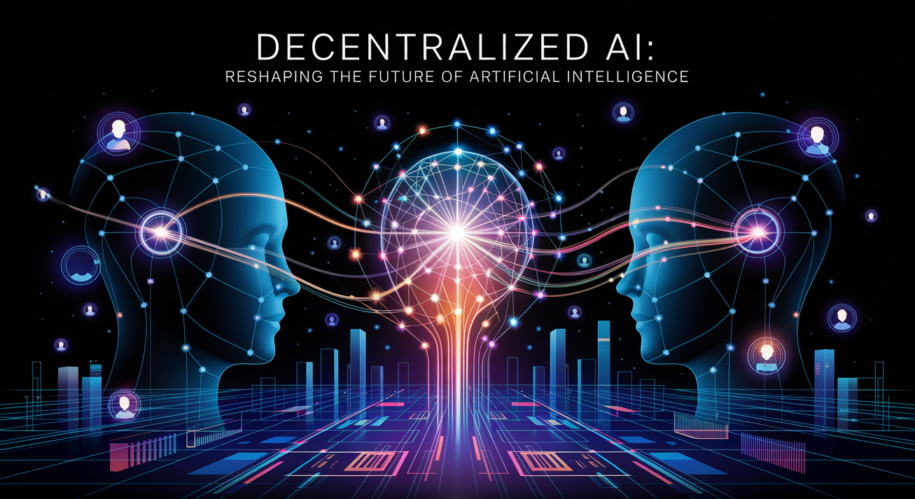
Imagine a future where the world’s most brilliant medical researchers, scattered across continents, can collaborate on a single, massive dataset without ever compromising a single patient’s privacy. Sounds like science fiction, right? Well, that future is arriving today through Decentralized AI in Research. You see, we’ve unlocked the secret to building powerful artificial intelligence, but that AI is only as smart as the data we feed it. For years, we’ve been running into a huge, frustrating roadblock: sensitive data, like patient health records, is locked away in countless private databases.
1. The Data Silo Challenge
Data silos represent the primary barrier to advancing AI-driven research across global institutions, trapping valuable insights in isolated systems due to privacy regulations and security concerns. These silos prevent the scale needed for training robust models on rare events or diverse populations, stalling breakthroughs in fields like medicine and public health. Decentralized AI offers a transformative solution by enabling collaborative learning without data transfer.
1.1. The Critical Problem of Data Silos
Why do we face this challenge? The answer is simple: data silos. These are isolated pools of information held within a single institution, like a massive university hospital or a pharmaceutical company. These silos exist for very good, legal, and ethical reasons, primarily due to strict regulations like HIPAA in the US and GDPR in Europe. No hospital wants to risk a data breach, so they lock their data down, which is absolutely the right thing to do. However, this commitment to privacy creates a major bottleneck for scientific progress. Think about rare diseases: by definition, no single hospital has enough cases to train a truly robust AI model. We need a way to combine the knowledge of ten hospitals without physically combining the data. That’s why the concept of Decentralized AI in Research has become so critically important.
1.2. Defining Decentralized AI in Research
So, what exactly is it? Simply put, Decentralized AI in Research is a groundbreaking paradigm that shifts the computation of AI models away from a single, centralized server and moves it closer to the data source itself, typically a hospital’s private database. This revolutionary approach allows institutions to collaboratively train a powerful, shared AI model using their local, sensitive data without that data ever leaving their secure premises. It’s like gathering ten chefs to create the perfect recipe: they all contribute their secret ingredients (the data) but only share the final, perfected flavor profile (the trained model), never the raw components.
2. The Foundations of Secure Data Pooling
Before we dive into the technical wizardry, we need to understand the fundamental shift in thinking that secure data pooling requires. It’s not just about technology; it’s about governance, trust, and a shared ethical commitment.
2.1. Overcoming Legal and Ethical Hurdles
The single biggest obstacle to global research is the question of trust and compliance. How can a hospital in Germany trust a lab in the United States when their data laws are so different? Traditional data sharing requires cumbersome legal agreements and often requires data to be de-identified, a process that is never 100% foolproof and frequently degrades the data’s quality. Decentralized AI in Research sidesteps this entirely. By ensuring that only the mathematical updates to the model and not the raw patient records are shared, it effectively creates a mechanism that is “privacy by design,” making compliance with regulations far simpler and, more importantly, establishing a foundation of trust that is mathematically guaranteed.
2.2. A Simple Analogy: The Secure Digital Veto
To really grasp how this works, let’s use an analogy. Imagine a group of friends trying to decide on a group activity, but none of them want to reveal their own secret preference before the final decision is tallied. Each friend writes their vote (their private data) on a piece of paper and puts it into a sealed, non-transparent ballot box (the secure local environment). A shared calculator (the decentralized AI algorithm) can run a calculation across all the ballots while they are still sealed, revealing only the winning activity (the improved global model) and nothing about the individual votes. The original pieces of paper with the secret preferences never leave the ballot box. In this analogy, the ballot box acts as the secure digital environment, giving each institution a “veto” over its raw data’s use.
3. Two Pillars of Decentralized AI: Federated Learning and Secure Multi-Party Computation
When people talk about Decentralized AI in Research, they are usually referring to one of two core technologies that make this whole system run. Both are powerful, but they operate on different principles of privacy protection.
3.1. What is Federated Learning and How Does it Work?
Federated Learning (FL) is the most common technique in the decentralized AI world. Its principle is simple: the central server (say, a research consortium) sends a copy of the AI model to multiple participating institutions. Each institution trains the model locally using its own data. Once trained, the institution sends only the model’s updates (the changes in its mathematical parameters, often called gradients) back to the central server. The server then aggregates these updates from all participants, creating an improved global model, which is then sent back out for another round of training. The brilliance of FL is that the raw data never moves. Since only aggregated, mathematical changes are shared, the chances of inferring any individual patient’s data are greatly reduced. You can see how this can be crucial for topics like AI in Public Health Preparedness, where models need to learn from globally diverse outbreak data but must protect local health records.
3.2. Secure Multi-Party Computation (SMPC): The Gold Standard for Privacy
While Federated Learning is excellent, it still carries a small theoretical risk: an extremely clever attacker might be able to reverse engineer individual data points from the shared model updates. This is where Secure Multi-Party Computation (SMPC) steps in, providing the ultimate layer of cryptographic protection for Decentralized AI in Research. SMPC is a fascinating branch of cryptography that allows multiple parties to compute a function over their inputs while keeping those inputs private. Think of it as a guaranteed calculation where the data is encrypted at all times, even while the AI is training on it. The output is revealed only to the participating parties, and the raw input data is never decrypted during the process. This is the “gold standard” because it offers a mathematical proof of privacy, which is invaluable for highly sensitive applications like drug discovery or genetic research.
4. Decentralized AI in Research: Real-World Impact and Use Cases
This isn’t just theory; Decentralized AI in Research is actively changing medicine and science right now. The ability to securely pool data is unlocking solutions that were simply impossible just a few years ago.
4.1. Accelerating Rare Disease Diagnosis
As mentioned, rare diseases are a perfect example of a data silo problem. A disease affecting one in a million people might only have a handful of cases at any given hospital. By leveraging Federated Learning or SMPC, ten hospitals globally, each with five cases, can effectively train an AI model on fifty cases. This collective knowledge allows the AI to learn subtle, lifesaving patterns it would otherwise miss, accelerating diagnosis for patients who desperately need answers.
4.2. Enhancing Cross-Institutional Oncology Research
Cancer research is incredibly complex, requiring analysis of genetic data, imaging, and patient outcomes. Different global institutions often specialize in different cancer types or patient demographics. By using Decentralized AI in Research, researchers can collaborate on building a unified prediction model for treatment efficacy, using millions of patient records from around the world to inform personalized medicine strategies. This kind of work is at the cutting edge of Advancing Precision Oncology: The Future of Personalized Cancer Treatment and depends heavily on secure data handling.
4.3. Personalized Medicine Without Centralized Data
The dream of personalized medicine is a treatment plan tailored specifically to you and your unique biological profile. To achieve this, AI needs to compare your data to the largest, most diverse population dataset possible. Decentralized AI makes this comparison possible. Your local hospital can use your data to slightly refine a global model without that data ever traveling outside their firewall. This offers the promise of highly accurate, personalized treatments informed by global knowledge, all while your privacy is maintained locally.
5. The Technical Challenges of Implementing Decentralized AI in Research
While the benefits are enormous, getting this technology right is not without its hurdles. It’s a complex ecosystem that requires sophisticated technical and operational planning.
5.1. Ensuring Model Robustness and Data Homogeneity
One significant challenge is dealing with “nonIID” data, which stands for non-independently and identically distributed. In plain language, this means the data across different hospitals is often very different. A hospital in a tropical region will see different diseases and demographics than one in a temperate region. The AI model needs to be robust enough to learn from all these variations without having its overall performance degraded by a skewed local dataset. This requires smart aggregation techniques to ensure a reliable final model.
5.2. Managing Communication Overhead and Latency
Imagine a system where a model needs to be exchanged between fifty institutions every hour. That’s a lot of communication. Moving model updates, even if they are smaller than raw data, creates “communication overhead” and “latency” (delay). Researchers must find ways to compress these updates and schedule the training rounds efficiently to ensure the system runs smoothly and produces results quickly enough to be useful in a research setting.
6. Building Trust: Cryptographic Techniques that Power Secure Data Pooling
The core of secure data pooling relies on cutting-edge cryptography that essentially turns data into a secure mathematical puzzle that can be solved only in a specific, privacy-preserving way.
6.1. The Role of Homomorphic Encryption (HE)
Homomorphic Encryption (HE) is one of the most exciting tools in the Decentralized AI in Research toolbox. It allows third parties (like the central server) to perform complex computations on encrypted data without ever needing to decrypt it. Think of a bank telling you: “You can send us an encrypted number, and we can add another encrypted number to it, giving you the encrypted total, and neither of us ever sees the original numbers.” HE is the technology that makes the “secure digital veto” analogy a reality, enabling computation on fully encrypted patient records.
6.2. The Importance of Blockchain for Auditing
As institutions collaborate, they need a clear, tamper-proof record of who contributed what, when, and how the shared model was updated. This is where an immutable audit trail, often powered by blockchain technology, becomes vital. Blockchain, as discussed in detail in Blockchain for Health Records: AI and immutable audit trails for GDPR/HIPAA, provides a decentralized, chronological, and cryptographically secured ledger for recording every model update and every data access request. This ensures transparency among consortium members and provides a powerful tool for regulatory compliance.
7. Overcoming Adoption Barriers: A Roadmap for Global Institutions
The potential of Decentralized AI in Research is undeniable, but it still requires a concerted effort to move from proof-of-concept projects to global standard practice. We have a clear path forward, but institutions need to commit.
7.1. Standardizing Data Formats and Protocols
The AI model will only be as good as its ability to understand the data it is training on. Currently, patient data formats can vary wildly from one hospital to the next. For secure data pooling to truly scale, the global research community must embrace and enforce common data standards and open-source protocols for model exchange. This standardization effort is essential for breaking down the technical silos that remain.
7.2. Training the Next Generation of Researchers
This new paradigm requires a new skillset. Researchers and data scientists need to understand not only AI and machine learning but also the complexities of cryptography, data governance, and privacy-preserving techniques like SMPC. Investing in training and education for instance, in areas like Synthetic Healthcare Data: Training models without compromising patient privacy is paramount to ensuring the sustained growth and ethical application of Decentralized AI in Research. You need to have the experts who can both train the model and audit the cryptographic proofs.
Conclusion: The Collaborative Horizon of Decentralized AI
Decentralized AI in Research is more than just a technological upgrade; it is an ethical breakthrough. It offers the first genuinely scalable solution to the long-standing conflict between the imperative for scientific collaboration and the non-negotiable right to patient privacy. By utilizing the dual powers of Federated Learning and Secure Multi-Party Computation, we can overcome data silos, accelerate the discovery of treatments for complex and rare diseases, and usher in a true era of global personalized medicine. It empowers researchers to work together, even if they are separated by continents and regulatory frameworks, by allowing them to share the knowledge derived from data without ever sharing the sensitive data itself. The future of medicine is collaborative, secure, and decentralized.
Frequently Asked Questions (FAQs)
1. What is the main difference between Federated Learning (FL) and Secure Multi-Party Computation (SMPC) in Decentralized AI in Research?
The core difference lies in the level of cryptographic privacy. FL shares model updates (gradients) that are aggregated by a central server, which is generally very private but not mathematically guaranteed against all possible attacks. SMPC, on the other hand, allows the entire computation to be performed on fully encrypted data, providing a strong, mathematical proof that no institution or third party can ever see the raw data, making it the highest standard for privacy in Decentralized AI in Research.
2. Can Decentralized AI techniques be used for non-medical research?
Absolutely. While healthcare is a prime example due to the highly sensitive nature of patient data, Decentralized AI in Research can be applied to any sector where data is valuable, sensitive, and siloed. This includes financial fraud detection across multiple banks, supply chain optimization across competing companies, or even industrial anomaly detection where factory data must remain proprietary.
3. How does this approach comply with regulations like GDPR and HIPAA?
By preventing the raw, identifiable data from ever leaving the local institution, Decentralized AI in Research drastically simplifies compliance. The data remains under the physical and legal control of the original owner, satisfying the strict data residency and access control requirements of regulations like GDPR and HIPAA. The shared information the model updates or the cryptographically secured computation results is not considered sensitive personal data, which is a major legal advantage.
4. What is the biggest hurdle to widespread adoption of Secure Data Pooling?
The biggest hurdle is generally not the technology itself, but the organizational and administrative complexities. It requires a significant upfront investment in shared technical infrastructure, the agreement of common data standards (as seen in AGI in Healthcare: The Future of Medicine where data quality is a focus), and the establishment of legal and governance frameworks for the research consortium. It requires organizational alignment across competing or non-affiliated institutions.
5. Does Decentralized AI in Research require the use of Blockchain?
No, it does not require blockchain, but the two technologies are highly complementary. The core techniques like Federated Learning and SMPC handle the secure computation. Blockchain is often integrated to provide an immutable and transparent ledger for governance, recording crucial details such as which institution contributed to which model version, when the model was trained, and verifying the integrity of the data inputs, thereby enhancing trust and auditability among the collaborating parties.
Leave a Reply