
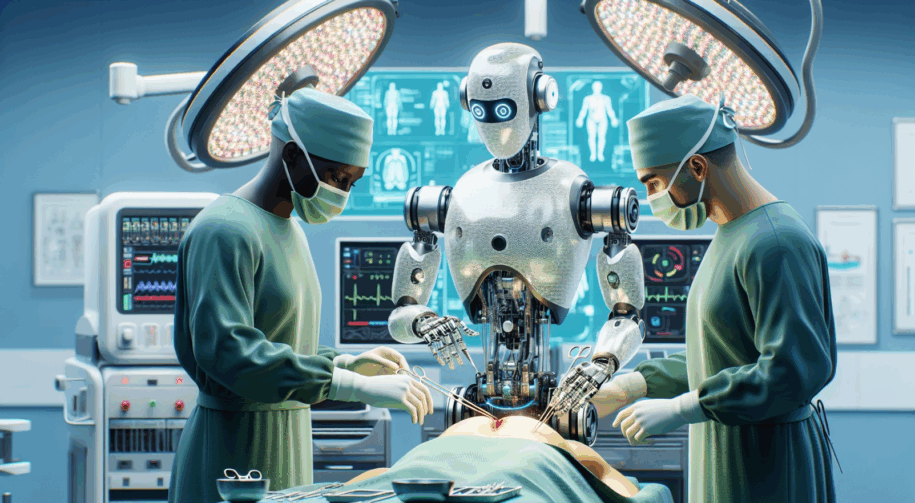
Have you ever stopped to think about the sheer complexity of a surgical procedure? It’s an art form perfected by years of training, where the difference between success and a complication can often come down to a fraction of a millimeter. For decades, robotic systems have offered surgeons a pair of steadier, more dexterous hands, allowing for smaller incisions and faster recovery times. But what happens when we give those incredibly precise hands a powerful, thinking brain? That’s the real revolution happening now: the integration of AI in Medical Robotics. We’re moving beyond simple teleoperation to create intelligent partners that don’t just execute commands, but anticipate and augment the surgeon’s skill in real time. This is the future of surgical care, and it’s being built right now.
1. The Revolution of AI in Medical Robotics
The operating room is fundamentally changing. It’s becoming less about a single surgeon’s physical dexterity and more about a collaborative, data-driven effort between human and machine. When you combine advanced Medical Robotics with sophisticated machine learning, you unlock capabilities that were once firmly in the realm of science fiction. We’re talking about giving surgeons what amounts to a “superpower” inside the patient’s body, transforming the human-machine partnership into something truly symbiotic.
1.1. Why the Operating Room Needs Smarter Machines
Let’s be honest, even the most experienced human surgeon can get fatigued during a ten-hour procedure. Human factors like hand tremor, physical strain, or even the slight variability that comes with being human can impact outcomes. Robotic Surgery AI is designed to eliminate these variables. By consistently processing and analyzing data faster than any person could, the AI acts as a constant, objective safety net and performance optimizer. It ensures that every single cut, stitch, and maneuver is executed with the maximum possible accuracy, essentially democratizing surgical excellence. We’ve seen how AI can transform hospital administration (5 Applications of OpenAI’s AgentKit in Healthcare Automation); now imagine that same power applied to saving a life on the operating table.
2. Deepening Surgical Precision with AI in Medical Robotics
The primary goal of integrating AI in Medical Robotics is to achieve unprecedented levels of precision. This isn’t just about making a tiny incision; it’s about micro-adjustments on the cellular level, ensuring that critical structures are protected and only the target tissue is affected. The technology allows the robot to perform tasks with a mechanical stability and reproducibility that the human hand simply can’t match.
2.1. The Role of Computer Vision in Surgical Mapping
Inside the body, the surgical field is a maze of similar-looking tissues. This is where AI’s visual intelligence shines. Using advanced computer vision and machine learning models, the robot’s cameras don’t just show the surgeon what is there; they label it. The AI can instantly segment a tumor from healthy tissue, identify a tiny nerve bundle, or map the exact location of a critical blood vessel in real-time. This dynamic, augmented visualization is like having an X-ray vision layered over the live video feed. This enhanced situational awareness drastically improves decision-making, leading to cleaner tumor margins and a reduced risk of accidental injury. We already rely on Explainable AI (XAI) in Clinical Decisions: Building Clinician Trust for diagnostics, and that trust is now being built directly into the operating instruments (Explainable AI (XAI) in Clinical Decisions: Building Clinician Trust).
2.2. Real-Time Error Correction and Haptic Feedback
One of the most exciting advancements in AI in Medical Robotics is the development of intelligent, real-time safety measures. Think of it as an automatic cruise control system, but for a surgical instrument. The AI constantly monitors the instrument’s position relative to the surrounding anatomy. If the surgeon’s hand movement accidentally drifts toward a boundary set by the AI, say, dangerously close to a major artery, the system can instantly and subtly damp the robot’s movement, a concept known as a “virtual fixture.” Furthermore, the integration of real-time haptic feedback (a sense of touch) allows the surgeon to feel the resistance of tissue, which is often lost in traditional robotic systems. The AI processes this tactile data, giving the surgeon a nuanced understanding of tissue density and tension, which is vital for delicate work like suturing or dissection. According to studies, these advancements are not just theoretical, showing significant improvements in surgical outcomes through higher precision and efficiency (The rise of robotics and AI-assisted surgery in modern healthcare).
3. The Shift Towards Autonomy with AI in Medical Robotics
The ultimate goal of Surgical Automation isn’t to replace the surgeon, but to move certain repetitive, high-precision tasks from manual control to supervised autonomy. This frees the surgeon’s attention to focus on the truly complex, strategic aspects of the operation. This evolution is happening in stages, increasing the level of machine independence as safety protocols are established.
3.1. Understanding Levels of Autonomy in Robotic Surgery
Surgical autonomy isn’t a simple on/off switch; it exists on a spectrum. Today, most systems operate at a co-pilot level, where the surgeon is in full control, and the AI offers assistance like tremor filtering and guided trajectory. The next level involves task-specific autonomy, where the AI performs a small, defined, and often repetitive task, such as automated suturing or knot tying, but only after receiving explicit permission from the surgeon. Eventually, as machine learning models prove their robustness across diverse patient anatomies, we may see systems capable of supervised autonomy for entire procedural steps. However, human oversight and the right ethical framework will always be mandatory (Autonomy in surgical robots and its meaningful human control).
3.2. Intraoperative AI: Recognizing and Automating Surgical Workflow Steps
A crucial component of supervised autonomy is the AI’s ability to understand the surgical context. This is known as surgical workflow recognition. Imagine the AI watching the operation and knowing, with high certainty, whether the surgeon is in the dissection phase, the clipping phase, or the suturing phase. By recognizing the current step, the intraoperative AI can proactively adjust instrument settings, display relevant information, or even prepare the next tool much like a very experienced scrub nurse, but with superhuman recall. This context-aware intelligence is fundamental to making AI in Medical Robotics truly beneficial for both patient and physician. It’s an application of technology that helps us make sense of complex data streams in real time (Biomarkers & AI: Objective health measures from passive data).
4. Overcoming the Hurdles: Ethics, Trust, and Data
Despite the incredible promise, adopting AI in Medical Robotics is not without challenges. These highly sophisticated systems are expensive, raising concerns about equitable access to this advanced care across different hospitals and populations ( AI and Robotic Surgery in Clinical Medicine). Furthermore, the ethical and regulatory landscape is still playing catch-up. If an autonomous system makes a mistake, who is held accountable? Is it the surgeon, the hospital, or the software manufacturer? This question of accountability necessitates robust regulatory oversight. Finally, these AI systems require massive amounts of high-quality, annotated surgical data to train properly. Ensuring data privacy, security, and diversity for these learning models is a continuous, paramount concern (Top Cybersecurity Risks Facing AI-Driven Healthcare Systems) (AI Employees Are Coming: Navigating Cybersecurity in the Age of Virtual Workers).
5. A New Partnership for Patient Care
The fusion of AI in Medical Robotics is more than just a technological upgrade; it is a fundamental redesign of the surgical process. By enhancing dexterity, providing augmented vision, and enabling a safe, measured progression toward autonomy, this technology is raising the bar for patient care globally. The goal isn’t to take the human out of the loop, but to amplify human capability, minimize error, and make ultra-precise surgery the standard, not the exception. The future of the operating room is a partnership, one where the surgeon’s wisdom and intuition are perfectly complemented by the robot’s unparalleled precision and the AI’s data-driven intelligence. This is the precision revolution, and it promises a safer, more predictable future for surgical patients everywhere (AI in Surgical Robotics: Advancing Precision and Minimizing Human Error).
Frequently Asked Questions (FAQs)
1. How does AI in Medical Robotics specifically improve surgical precision?
AI in Medical Robotics improves precision by filtering out even microscopic hand tremors, controlling instruments with sub-millimeter accuracy, and using computer vision to provide real-time error correction. The AI can identify and highlight critical anatomical structures like nerves or tumor margins that might be hard to distinguish with the naked eye, ensuring the surgeon operates with maximum accuracy and minimal collateral damage.
2. Is a fully autonomous surgical robot going to replace human surgeons?
No, the current and near-future focus of Surgical Automation is on supervised autonomy and augmentation, not replacement. The role of Robotic Surgery AI is to act as an intelligent co-pilot, handling highly repetitive, precision-intensive tasks like suturing, which allows the human surgeon to focus their critical thinking and strategic expertise on the complex, unique aspects of the operation.
3. What is haptic feedback, and how does AI use it in robotic surgery?
Haptic feedback refers to the sense of touch or force a surgeon feels through the robotic controls. Traditional systems often filter this out. AI systems, however, are being developed to process and transmit this tactile data back to the surgeon, letting them “feel” the stiffness or tension of tissue. This significantly enhances the surgeon’s dexterity and reduces the risk of accidentally tearing delicate tissue during complex procedures.
4. What are the main barriers to adopting AI-powered robotic surgery more widely?
The primary barriers are the high initial cost of the advanced Medical Robotics systems, which can limit their availability to top-tier hospitals, and the complex ethical and regulatory questions surrounding accountability if an AI-assisted procedure goes wrong. Additionally, the AI needs massive, diverse datasets for training, which poses data privacy and security challenges.
5. How is AI moving beyond simple robotics to truly “intelligent” systems?
The key difference lies in the AI’s ability to move from simply executing commands to understanding the surgical workflow and providing predictive assistance. Intelligent systems use machine learning to recognize the stage of the procedure, predict potential complications before they occur, and offer real-time, context-aware suggestions, essentially providing a layer of cognitive assistance in addition to mechanical precision.
Leave a Reply