
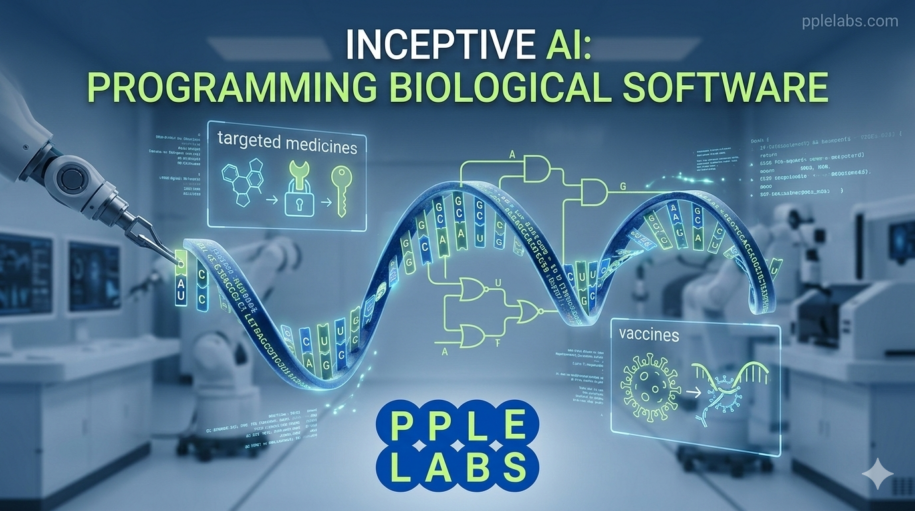
Have you ever stopped to think about your body as a high performance computer? If our DNA is the hard drive and our proteins are the hardware, then RNA is the software that tells everything what to do. This is precisely where Inceptive AI comes into play. We are entering an era where we no longer just hope to find a cure by accident in a forest or a petri dish. Instead, we are learning to write the code of life itself.
1. Introduction to Inceptive AI: The Dawn of Programmable Life
When we talk about Inceptive AI, we are talking about a massive shift in how humanity approaches sickness. Founded by Jakob Uszkoreit, one of the brilliant minds behind the “Transformer” architecture that powered the ChatGPT revolution, this company isn’t just another biotech startup. It is a bridge between the world of silicon and the world of cells. The goal of Inceptive AI is to treat biological molecules like lines of code that can be edited, optimized, and deployed to fix specific health issues.
Imagine a world where a new virus emerges, and within days, we aren’t just testing random chemicals, but literally “typing” a vaccine into existence. That is the promise of Inceptive AI. By using deep learning to understand the complex language of RNA, they are making it possible to design medicines that are highly targeted and incredibly efficient. It is a concept often discussed in the broader scope of AGI in healthcare, where machines mimic human reasoning to solve the most complex puzzles of our biology.
2. Understanding the Concept of Inceptive-AI Biological Software
So, what exactly do we mean by “biological software”? In the traditional sense, software is a set of instructions for a computer. In the world of Inceptive AI, biological software is a synthetic molecule designed to execute a specific function inside a living system. It is like an app for your cells. Instead of a “one size fits all” pill, you get a custom piece of biological code that knows exactly which protein to build or which gene to turn off.
The beauty of using Inceptive AI for this task lies in the complexity of RNA. RNA molecules can fold into trillions of different shapes. For a human, trying to predict which shape will work is like trying to solve a billion piece jigsaw puzzle in the dark. But for Inceptive AI, it is just data. By treating biology as a searchable, digital map—a concept we also see in the work of Recursion AI—they can find the perfect “code” for a specific medical outcome. This is the heart of designing better RNA medicines, where AI becomes the architect of our future health.
3. The Tech Behind the Scenes: How Inceptive Designs RNA
How does the magic actually happen? The secret sauce of Inceptive AI is its “antedisciplinary” approach. This means they don’t just have biologists in one room and coders in another. They have people who speak both languages fluently. The platform uses foundation models—similar to the ones that understand human speech—to learn the “grammar” of biology.
This process involves a constant feedback loop. The Inceptive AI model suggests a design, and then massive, automated “wet labs” actually build and test it. The results are fed back into the AI to make it smarter. It is a cycle of digital imagination and physical reality. This level of automation is transforming the industry, much like how Paige AI has set new standards in digital pathology by recognizing patterns no human could ever memorize. By scaling these experiments, Inceptive AI is able to explore a design space that is literally larger than the number of atoms in the universe.
4. Real World Impact: Applications of Inceptive Biological Software
The implications of Inceptive AI are staggering. We aren’t just talking about better flu shots. We are talking about a fundamental rewrite of the medical playbook. For example, during the development of mRNA vaccines, the challenge was keeping the RNA stable enough to do its job. With Inceptive AI, we can design RNA that is naturally more robust, easier to store, and more effective at a lower dose.
This technology also opens doors for precision oncology. By using DNA and RNA sequencing to identify unique mutations—a strategy pioneered by Tempus AI—Inceptive AI can then design a custom therapeutic “software” to target that specific cancer. This moves us away from the “trial and error” phase of medicine and toward a future where every treatment is a “targeted strike.” It is similar to how AI for Antimicrobial Resistance helps us stay one step ahead of superbugs by predicting their next move. You can read more about these breakthroughs in Nature Biotechnology or explore the latest WHO tech reports.
5. The Future of Medicine: Why Inceptive is a Game Changer
As we look toward the end of 2026, the influence of Inceptive AI is only growing. The traditional pharma model is slow and expensive, with a 90% failure rate in human trials. Inceptive AI aims to flip that script. By using “biological software,” we can reduce the guesswork and bring life saving treatments to patients in months rather than years.
The ability to program life is no longer science fiction. It is a reality being built in the labs of Inceptive AI. Whether it is automating the administrative drudgery of healthcare with tools like Notable Health or redesigning the very molecules that keep us alive, the goal is the same: to make medicine more human by making it more intelligent. The journey from a digital program to a life saving medicine has never been shorter, and the future of Inceptive AI is just getting started.
Conclusion
In conclusion, Inceptive AI is not just building drugs; it is building a new way to interact with our own biology. By treating RNA as biological software, Jakob Uszkoreit and his team are providing the tools to solve diseases that were previously thought to be “undruggable.” This fusion of deep learning and molecular biology represents the most significant leap in medicine since the discovery of antibiotics. As we continue to refine these “programs,” the potential to impact billions of lives becomes not just a hope, but a calculated certainty.
FAQs
1. What exactly is Inceptive AI? Inceptive AI is a biotechnology company that uses generative AI and deep learning to design “biological software,” specifically novel RNA molecules for vaccines and therapeutics.
2. How does Inceptive AI differ from traditional drug discovery? Traditional methods rely on trial and error or finding natural compounds. Inceptive AI uses a rational design approach, “programming” specific molecules to perform exact functions within the body.
3. Who founded Inceptive? The company was co founded by Jakob Uszkoreit, a pioneer in AI who co authored the foundational “Attention Is All You Need” paper that introduced the Transformer architecture.
4. Why is RNA considered “biological software”? RNA carries instructions from our DNA to our cells. Because it is a sequence of nucleotides, it acts as a code that Inceptive can program to produce specific therapeutic effects.
5. Is Inceptive AI currently being used for vaccines? Yes, a primary focus of Inceptive AI is the design of next generation mRNA molecules that are more stable and effective, which is a key component of modern vaccine technology.
Leave a Reply