
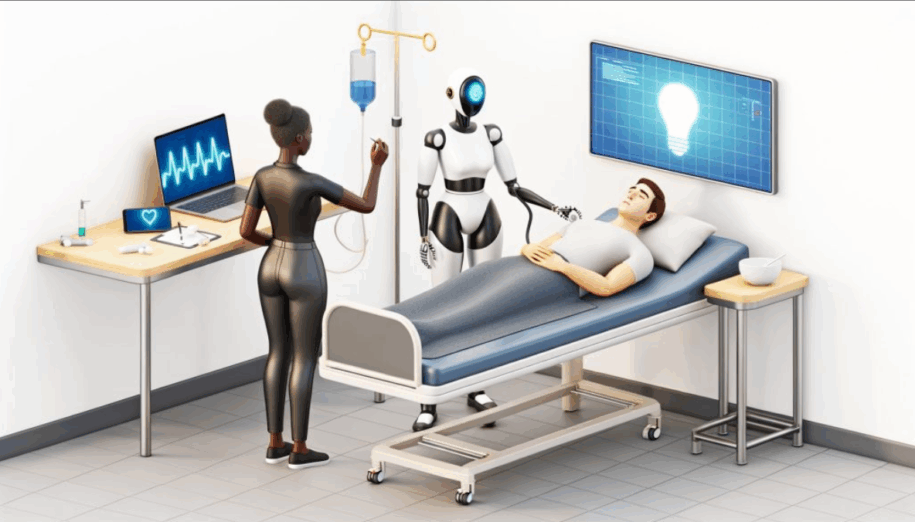
If you’ve ever found yourself sitting in a busy Emergency Room (ER) waiting area, you know the feeling of anxiety and frustration. That crowded, chaotic environment is the daily reality for hospitals everywhere. It’s a systemic issue where delays aren’t just inconvenient; they can be the difference between life and death. The heart of the problem? The bottleneck at the very beginning: triage. When patient volume spikes, even the most dedicated nurses and doctors struggle to keep up with the manual process of sorting and prioritizing. But what if we could replace the subjective, high-stress, manual process with something that uses data, not gut feeling, to instantly know who needs help now? That’s where AI-Powered Digital Triage steps in, offering a revolutionary path to finally achieve true Emergency Room Optimization. This isn’t just a tech upgrade; it’s a fundamental change in how we manage life-saving care.
1. Understanding the Bottleneck: Why Traditional Triage Fails to Optimize Patient Flow
Let’s be honest: traditional triage is a tough job. A triage nurse has to make critical, rapid decisions with limited information and under immense pressure. It’s a system designed decades ago that simply cannot cope with the complex, high-volume environment of the modern hospital.
1.1. The Subjective Nature of Manual Triage
Picture two patients presenting with similar symptoms, say, mild chest pain. Triage guidelines provide a framework, but the final decision is still filtered through human perception, fatigue, and experience. This is what we call subjectivity, and it introduces inconsistency. If Patient A is seen by a seasoned veteran and Patient B by a newly qualified nurse, their triage scores, and therefore their wait times, could be wildly different. This inconsistency is a silent enemy of Emergency Room Optimization, leading to “false positives” (patients who wait who shouldn’t have to) and, worse, “false negatives” (patients who are low-prioritized but are actually deteriorating). To truly streamline care, we need a system that removes this human variability. You can see how other areas of healthcare are addressing this by exploring the role of Explainable AI (XAI) in Clinical Decisions.
1.2. The Staggering Cost of Inefficient Emergency Room Optimization
The fallout from poor patient flow is enormous. Long wait times lead to patients leaving the ER without being seen—a serious risk to public health and a financial hit to the hospital. Delayed care for high-acuity patients, often called “boarders,” in hallways increases the risk of negative health outcomes, legal liabilities, and massive staff burnout. When the system is constantly reacting rather than proactively managing, it’s operating far below its potential. The inability to predict the flow of patients—their acuity, their disposition (admission, discharge, or transfer)—is the core weakness that AI-Powered Digital Triage is designed to fix.
2. How AI-Powered Digital Triage Actually Works
So, how does artificial intelligence perform this seemingly impossible task better than a highly-trained human? The key lies in its ability to process, connect, and learn from data at a scale no human mind ever could.
2.1. From Data to Decision: The Engine of Predictive Triage Models
AI-Powered Digital Triage systems use sophisticated machine learning models, which are trained on vast datasets of past patient visits. These models don’t just look at the four or five data points a human triage nurse does; they analyze hundreds. Think about it: vital signs, chief complaint, age, co-morbidities, past lab results, current medication lists, and even real-time data from Precision Digital Biomarkers and AI.
When a new patient arrives, the AI instantly digests all this information to generate a predictive triage model score. This score goes beyond a simple “urgent” or “non-urgent” to predict things like the patient’s likelihood of being admitted to the ICU, the chance of a critical event in the next four hours, and even their estimated length of stay. This data-driven, nuanced assessment is far more accurate than any traditional scoring system. Want to see how technology changes complex processes? Check out this post on LLMs in Hospital Administration.
2.2. Real-Time Resource Allocation and Intelligent Queuing
This is where the magic of AI-Powered Digital Triage truly transforms hospital operations. It doesn’t just score the patient; it uses that score to drive intelligent action. Imagine the AI seeing a patient whose score suggests a 40% chance of needing a respiratory therapist and an available bed in the telemetry unit. The system then automatically triggers an alert to the staff and begins the resource allocation process before the patient even reaches the treatment area.
- Instead of waiting for a bed, the patient is channeled directly to a pre-assigned, appropriate location (Intelligent Queuing).
- The system can forecast a spike in critical cases and advise the charge nurse to pull staff from lower-acuity zones to the trauma bay, or even call in a backup team.
It’s like turning the chaos of the ER into a finely tuned air traffic control tower, where every flight is guided to the right gate with perfect timing.
3. Key Benefits of AI-Powered Digital Triage in Hospital Operations
The adoption of AI-Powered Digital Triage isn’t a luxury for hospitals; it’s rapidly becoming a necessity, driven by the measurable and life-saving benefits it delivers.
3.1. Drastically Reducing Wait Times and Improving Patient Experience
The most immediate and obvious benefit is the reduction in the infamous Emergency Room wait time. Studies in pilot programs around the world show that by stratifying risk more effectively, AI can shave significant time off the assessment process. When low-acuity patients are diverted to fast-track zones or virtual care, and high-acuity patients are immediately flagged and rushed to treatment, the overall throughput efficiency soars. Happier patients, less stress, and quicker recovery times are the reward. We’ve seen similar efficiency gains in other high-stakes areas like AI for Clinical Trial Site Selection.
3.2. Enhancing Accuracy and Consistency of Triage Decisions
Accuracy saves lives. The AI doesn’t get tired, distracted, or biased. It maintains a consistent standard of assessment for every single person who walks through the door. This consistency means that a life-threatening condition, like early-stage sepsis or a subtle cardiac event, is less likely to be missed in the shuffle. The AI’s ability to recognize patterns invisible to the human eye acts as a tireless safety net for clinical teams. This kind of improved efficiency is also seen in supply chain optimization, as discussed in AI in Healthcare Supply Chain Management.
4. Overcoming Implementation Hurdles in AI-Powered Digital Triage
While the promise of AI-Powered Digital Triage is compelling, adopting this technology isn’t simply a matter of plugging in a new piece of software. Healthcare leaders must address real-world concerns to ensure successful integration.
The single biggest hurdle is often clinician trust. Nurses and doctors are skeptical of “black box” algorithms, especially in critical care. They want to know why the AI made a certain recommendation before they stake a patient’s life on it. This is why AI solutions must be transparent and offer clear, explainable reasoning to support their decisions. Furthermore, the data used to train the models must be diverse and high-quality, or the algorithms could perpetuate existing systemic biases, leading to unequal care for different demographic groups. For more on navigating the ethical side of tech, see Sovereign AI in Healthcare.
Hospitals must also invest in the necessary IT infrastructure to seamlessly integrate the AI with Electronic Health Records (EHRs). A disconnected system is a useless system. As the American College of Emergency Physicians (ACEP) notes, the technology must be validated in real-world settings to prove its benefit and safety, not just in a lab. You can find more authoritative research on its real-world impact in this Journal of Medical Internet Research article on the applications of AI in emergency medicine.
The Future of Emergency Care is AI-Powered Digital Triage
The Emergency Room is a high-stakes arena where minutes matter. The traditional, manual triage system is simply reaching its limit under the weight of modern healthcare demands. AI-Powered Digital Triage is not just an incremental improvement; it’s a foundational shift, using the power of predictive analytics to transform chaos into order. By moving from a reactive process to a proactive, intelligent system, hospitals can drastically reduce wait times, boost accuracy, and, most importantly, provide quicker, more equitable care to everyone who walks through the door. This isn’t about replacing the human element; it’s about giving our tireless healthcare heroes a superhuman tool to make the most critical decisions with speed and precision.
Frequently Asked Questions (FAQs)
1. Will AI-Powered Digital Triage replace human triage nurses?
Absolutely not. AI-Powered Digital Triage is a decision-support tool, not a replacement. The AI handles the massive data processing and risk-stratification, but the human nurse provides the essential empathy, physical assessment, and clinical judgment needed for final care decisions. It takes the administrative burden off the nurse, allowing them to focus on direct patient interaction.
2. How does the AI ensure it isn’t biased against certain patient groups?
Algorithmic bias is a significant concern. Reputable AI systems are trained on diverse datasets and continuously monitored and audited by human teams. The goal is to identify and correct any unintended bias to ensure the AI’s predictions are fair and equitable across all demographics, ultimately promoting better care consistency. For more on how to manage this, you can look up guidelines from the National Institute of Standards and Technology (NIST) on mitigating AI bias.
3. Is AI-Powered Digital Triage only for high-volume urban hospitals?
No. While large hospitals certainly benefit from better patient flow, AI-Powered Digital Triage is proving incredibly valuable in smaller or rural facilities. In these settings, it can help staff with less specialized experience make more accurate, life-saving initial assessments, ensuring that critical patients are transferred to the appropriate care center faster. Research from the Yale School of Public Health highlights the promise of AI triage platforms for managing patient severity.
4. How quickly can a hospital implement AI-Powered Digital Triage and see results?
Implementation time varies widely depending on the hospital’s existing IT infrastructure and EHR system. While the integration phase can take several months, many hospitals report seeing measurable improvements in key metrics, such as a reduction in patients leaving without being seen and shorter door-to-treatment times, within the first three to six months of full operational use.
5. Can AI Triage help with resource allocation beyond just doctors and nurses?
Yes, that is a core function of modern AI-Powered Digital Triage. It doesn’t just prioritize patients; it optimizes the use of all resources. This includes predicting the need for specific equipment (like ventilators), determining if a certain specialty consultant will be required, and managing the dynamic allocation of treatment rooms or beds based on forecasted patient demand and acuity. This is vital for overall Hospital Operations. You can find more detail on this resource planning aspect in this comprehensive JMIR Medical Informatics article.
Leave a Reply