
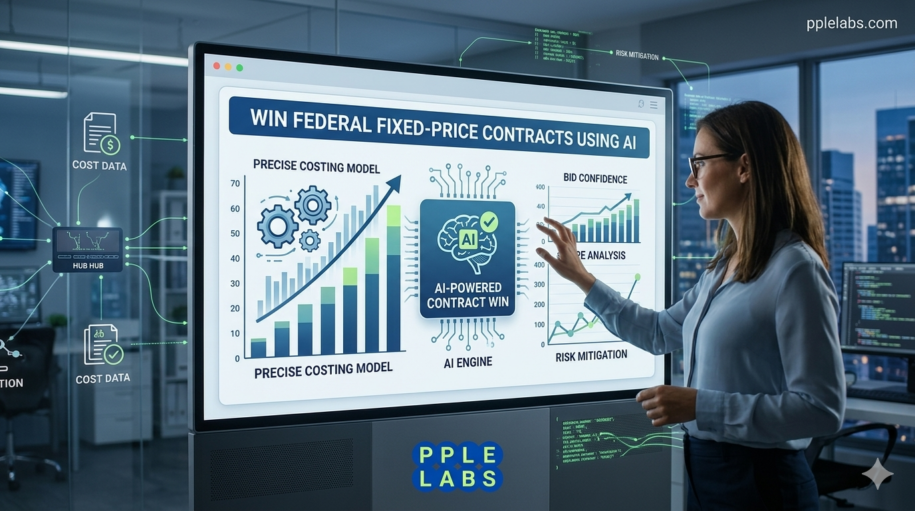
The rules of the government procurement arena just went through a major transformation. A recent executive order turned the entire contracting landscape upside down by making federal fixed price contracts the absolute default choice for every agency. This means the cozy safety net of cost reimbursement deals is vanishing fast. If you are a small business owner navigating this space, you are likely looking at a completely different playing field where accuracy is the only currency that matters. Let us explore how you can use artificial intelligence to not just survive this policy shift but completely dominate the competition.
1. Introduction to the New Procurement Reality
The sudden shift toward federal fixed price contracts has sent shockwaves through the small business community. Every procurement officer is now forced to move away from flexible spending models to rigid pricing agreements. With Office of Management and Budget guidelines arriving swiftly and Federal Acquisition Regulation amendments finalizing by late summer, the timeline to adapt is incredibly short. This means you can no longer rely on mid project financial adjustments to save a poorly planned proposal.
Why traditional estimation guessing games are officially dead is a lesson many will unfortunately learn the hard way. For years, smaller firms could get away with rough estimates, assuming that unforeseen overhead costs could be worked out later during contract execution. Those days are gone. Under the new regime, precision is mandatory from the very moment you hit the submit button on an open solicitation.
2. The Double Edged Sword of Federal Fixed Price Contracts
The positive side of federal fixed price contracts offers a highly refreshing change of pace for businesses that enjoy structural clarity. When you secure a well planned agreement, your revenue stream becomes highly predictable, allowing you to manage your cash flow with extreme confidence. Furthermore, these agreements require far cleaner project scopes and significantly less complex accounting overhead compared to traditional cost plus models. You spend less time filling out meticulous government audit paperwork and far more time actually delivering elite work.
The difficult reality of federal fixed price contracts is that they introduce an unrelenting environment of financial risk. There is absolutely zero room for vague scopes or hidden pricing padding. If your field team runs into unexpected project delays, supply chain price hikes, or technical challenges, you cannot request additional funding. If you underbid the job, your business must absorb the extra expenses completely, which can quickly turn a major government win into a devastating financial loss.
3. Why Small Businesses Fail the Federal Fixed Price Contracts Scrutiny
The widespread lack of formal pricing methodologies is the single biggest vulnerability facing small government vendors today. When we analyze how boutique firms calculate their operational fees, we often find a messy combination of old spreadsheets, outdated supplier quotes, and pure instinct. This disorganized approach fails immediately when put under intense procurement evaluation, leaving companies highly exposed to sudden market inflation. To understand how to properly structure these bids, looking at historical data on modern operations via Pplelabs can provide crucial operational perspectives.
Moving past the dangerous submit and hope bidding method requires a total mindset overhaul. You can no longer afford to throw a random number at a request for proposal and pray that it covers your actual material costs. Surviving this rigorous landscape means you must treat pricing as an exact science. Every single hour of labor, every piece of equipment, and every minor compliance fee must be perfectly accounted for before the contract is officially signed.
4. How AI Transforms Bidding for Federal Fixed Price Contracts
Building bulletproof costing models with machine intelligence is the ultimate way to level the playing field. Advanced artificial intelligence tools can process massive volumes of complex solicitation data within seconds, identifying historical pricing patterns that a human eye would easily miss. These intelligent systems allow you to confidently establish a highly competitive bid while ensuring your business stays protected. For businesses looking into deep digital workflows, researching modern automation platforms at Pplelabs reveals how advanced technology changes project delivery.
Automating risk variables and protecting your net profit margins is where machine learning truly shines. An AI tool can instantly simulate thousands of potential project scenarios, including sudden labor shortages or material cost spikes. This predictive capability allows you to construct a highly resilient cost model that keeps your business profitable even when things go wrong during execution. To review how data structures impact long term business compliance, checking out the federal guidelines on contract classifications at Acquisition.gov offers vital structural insight.

5. Step by Step Guide to Win Federal Fixed Price Contracts Using AI
Historical data scraping and precise scope engineering are the initial steps to mastering this new tech driven approach. By training an AI model on your past corporate performance metrics, you can quickly generate highly accurate estimates for future labor requirements. The software reviews your previous projects to determine the exact number of hours needed to complete specific technical tasks. To see how specialized technology teams optimize their internal data pipelines, checking the operational workflows at Pplelabs offers great inspiration.
Creating algorithmic defensibility for your next government proposal gives you an incredible advantage during negotiations. When a procurement officer questions your final pricing, you can present a highly detailed, data backed report generated by your AI system. This level of extreme transparency proves to the government that your numbers are rooted in real world metrics rather than hopeful guesswork. For deeper insights into how federal agencies evaluate complex technical risk profiles, reading the defense procurement guidelines on Defense Procurement and Acquisition Policy provides an excellent benchmark.
Conclusion and Strategic Next Steps
The transition to fixed price procurement is a massive turning point that will completely redefine who wins in the federal marketplace. By embracing artificial intelligence to build bulletproof costing models, you completely eliminate the dangerous guesswork that ruins so many small firms. Do not wait for the upcoming regulatory deadlines to force your hand. Start building your advanced, data driven costing model today so you can protect your margins and bid with absolute certainty.
Frequently Asked Questions
- 1. What are federal fixed price contracts? These are government agreements where the final price is set at the very beginning and remains completely unchanged regardless of the contractor’s actual internal costs during performance.
- 2. How does AI help with government bidding? AI analyzes massive volumes of historical solicitation data, accurately predicts potential project risk variables, and automates complex cost calculations to ensure your profit margins remain perfectly protected.
- 3. Can small businesses still use cost reimbursement models? While cost reimbursement models still exist for highly specialized research, recent executive mandates have made fixed pricing the absolute default option across federal agencies.
- 4. What happens if I underbid a fixed price agreement? If your final operational expenses exceed your initial proposed bid, your company must absorb the excess costs entirely without any additional financial help from the government.
- 5. Where can I find free AI tools for government contracting? You can access highly specialized tools by dropping a comment with Govcon AI on our primary platform to receive an invite to a private, custom built costing assistant.
Leave a Reply